Search This Blog

Showing posts with label hero journey. Show all posts

Friday, December 27, 2013

Appalachia Project: Christy, 1967

Christy, by Catherine Marshall, 1967

In 1912, young Christy Huddleston is inspired by a sermon to move to one of the poorest areas of Appalachia to teach at a mission school. She faces danger, sickness, and ignorance, but also beauty, friendship, and love. The book is a love story, a mystery, a bit of (specious?) anthropology, and a coming-of-age story, but primarily it is the story of Christy's spiritual journey from an other-directed theology to a personal experience of a personal god.

In a way Christy is a classic governess story, in the same vein as "The Sound of Music" or a Phyllis Whitney novel. Ingenue travels to alien place to grow up and find love with the alpha male. Winning the trust of children is always a part of it. Marshall chose an intriguing setting, the fictional mountain area called Cutter Gap, set in the hollers and ridgetops of the Smokies. And she added the depiction of Christy's spiritual growth. Both of these decisions elevated the book above "summer paperback" status.

Christy is set in the fictional Cutter Gap, near the fictional El Plano in East Tennessee. The setting is near the town of Del Rio, Tennessee, which is right on the Tennessee/North Carolina border about 60 miles due east of Knoxville. In the 1930s, as happened in so many Appalachian communities, including the area of Ohio where I live, the federal government bought up land to create the national park system. Many remote communities were virtually dissolved at this time. If you can find the documentary "A Forest Returns," it will tell you this story as an oral history. View a short clip at http://youtu.be/pXNLh1K7Lmw or go to www.ohiolandscape.org.

I own this book and read it from the original paperback I have from 1968. I've read this book three or four times and always liked it. My old copy of it is fingerprinted and dog-eared. I don't think I read Christy until I was in junior high school, though, maybe between 1970 and 1973 or so. Several of my old friends from the "Bloomfield Mafia" Facebook group suggested that this book be put on the list, so many of us must have read it around the same time. My sister Judy Graybill read it, also. The paper was yellowed and the type was fading, so I read all 500+ pages with a magnifying glass--quite a two-handed chore. This is the first time I've had to read this way and it has spurred me to make an eye doctor appointment in the near future. Marshall's tight plotting of the story kept me reading despite the inconvenience.

Marshall's writing is clear and vivid and loving, in that the author is lovingly retelling the story of her mother's early adulthood, events that had taken on legendary prominence in Marshall's childhood. Marshall visited the mountain community and captured lively detail. Christy's sense of smell is almost a featured character in the book and led to the inclusion of odors and scents with almost every scene, which placed me right in the picture. In a grotesque scene in which Christy must change a teenage boy's diaper, which he has soiled with typhoid diarrhea, Christy's decision to put a clothespin on her nose provided just enough humor to get me through.

And, from my own experiences with the poor, I understand the odor thing. Many people I come in contact with have body odor, or the odor of unwashed clothing, or a miasma of cigarette smoke (stale and fresh) hugging them like a fetid cloak. Like Christy, I force myself to put my nose aside while I'm with the person. But I keep a spray can of Fabreeze on my desk and spray away the smell as soon as the person has left the parking lot (if I spray too soon, they always catch me at it).

Besides the smells, Christy must deal with people who speak almost a different language, and who follow a code of behavior that she doesn't understand. She has to conquer her own squeamishness and missishness and is led therefrom to really see the other person, with the veil of self interest drawn back. In other words, Christy grows up.

As soon as the doctor says, "It's typhoid," the book shifts into a higher gear. Christy and the people in her life are fighting death, looking it right in the face. This section of the book is grueling and painful and sad. I agonized over which beloved character was going to be announced next to be ill. Part of this being a great book is this awakening of compassion in the reader, how much I cared. I was right there.

The ending of this novel is masterful, full of impact, stunning, really. If you follow this blog, you know how many times I have felt that the author just didn't know where to end. Not Marshall. Her last sentence is the most exciting one in the whole book. Pow. I was left with a feeling of elation and beauty, even jaded as I am and having read and reread this book. Good job!

The themes in Christy range from the power of love to the need to accept the gifts/trials life gives you. On page 27 in Chapter 1, Marshall describes the wind in the mountains--Christy is on her train trip to the mountains and steps off the train for a minute. "Now the snow was beginning to fall again, with the wind rising. It was a strange wind, a whimpering sobbing wind, with pain in it....But there was something different about this wind. It was not a single note, but many notes playing up and down the scale, harmonizing at one moment, discordant the next, retreating, advancing." This passage is the first real statement of theme, that the book will be about suffering and possibly transcendence and that you can't have one without the other.

In terms of the depiction of Appalachia, I realized that this story is really Christy's and that Appalachia is the backdrop for her growth and development as a person and as a Christian. The Appalachian people played sort of the "noble savage" role, and we did not at all hear their side of the story. Christy could have worked against many an underprivileged background (and has--this book is well-done, but the premise is time-honored). She marvelled at the good qualities, like they were a wonder, against the backdrop of squalor. 

The theme that God's love is personal and transformational was beautifully drawn, but it was the non-Appalachians who got transformed by it. The doctor (who was from Cutter Gap but had been educated out of its backwards ways), Christy, and David the preacher all used the Appalachian people and mountains as sort of (unchanging) catalysts for their own spiritual journeys. The book is an outsider's portrayal of the culture and people.

I think one of the reasons I love this book so much is that it is a true hero journey for Christy and some of the other characters. The classic theme of quest literature is strong here, that you have to lose yourself to find yourself. A strong female hero journey is hard to find. Christy was strong, individualized, self-determining, and brave. She faced the dangers and hazards inside herself as well as the ones outside her. The Gandalf role is played by a woman also, the spiritually attuned Alice Henderson.

This could be (left to right) the doctor, the
preacher, Christy, and Miss Ida (the
preacher's sister in Christy.
The book presents a picture of Appalachia and the picture is not inaccurate. But please keep in mind that it is not a story of Appalachia. You could substitute Middle Earth or Shangri-La or Moonbase Alpha or Camelot or the Land of Oz and tell the same story. The book is unabashedly Christian, and it does it well. I don't know how people from other faiths would feel about the story. You can read the story substituting "love" for the word god, probably, but that kind of awkward translation would probably ruin the experience.

All of the stereotypes of Appalachia are in this book--feuding, ignorance, unwashedness, sourness, frequent pregnancies, hopelessness on the one hand, and on the other the idealization of the musicality, artistic/folk gifts, and elevated Scots-Irish ancestry. The descriptions of landscape are breathtaking. I have not much comment to make on this. But I do look forward to other books in which the Appalachian voice is itself heard. I want to know what that voice has to say.

Saturday, March 16, 2013

The Witch of Blackbird Pond, by Elizabeth George Speare

At its most basic, The Witch of Blackbird Pond, by Elizabeth George Speare, follows the pattern of a fairy tale. The main character is forced to wander from her home, enters a world where all the rules are different and strange (to her), undergoes trials and tests, grows up a lot, then resolves it all in a happily-ever-after marital conclusion.

The fairy tale ending was a bit disappointing, given the imaginative setting and wonderful characterizations of this book, but seems appropriate for a book published in 1958. In fact, for 1958, the hero of this book is wonderfully imagined--her inner life is rich and she faces the epic conflicts of all great heroes--sacrifice vs. safety, self vs. community, self vs. family, right vs. wrong, freedom vs. duty, and so many more. This book reads as current--I had many ideas as to when it was written. It's a fine book--interesting and, in the best sense, sweet.

Blackbird Pond follows Kit Tyler as she flees her home in Barbados--colorful, urban, lush--and arrives in cold and stony colonial Connecticut, home of her only living relative, an aunt. The discovery of the New England landscape, its charms and perils, is one key feature of the book. A second key feature is Kit's introduction to the culture of Puritanism in the 1680s--diametrically opposite to almost all she has been taught. The third key feature is Kit's submersion in self-subsistance (work, in other words). These three strands are interesting all in themselves. Seeing the landscape, culture, and work through Kit's new eyes illuminated it for me, made the Puritan period way more three-dimensional than I had viewed it before.

And then there's witchcraft. Kit is first suspected of being a witch as her ship from Barbados comes into port. A child drops her doll into the water and Kit jumps in and swims out to get it. Scandalous. People in New England, apparently, do not swim. Kit, if she fears not the water, might be a witch. Witches float. Kit is a peculiar bird in the Connecticut aviary. For example, she has no work clothes, she can't cook or sew, and she doesn't understand silent obedience. Against her uncle's direct order, Kit develops a relationship with an old woman considered to be a witch in the community, which casts yet more suspicion upon her. The old woman is a Quaker (another peculiar bird).

Anyway, Kit's characteristics put her at odds with the community; her actions put her and others in danger. The fairy tale ending is a bit of a cop out because Kit's marriage will remove her from the Puritan community and give her back most of the freedoms she had been denied. So, did she change and grow? Yes. And this is a children's book, so a portrayal of a lifetime as a questionable outsider is not feasible. I just worry that the fairy tale ending short circuits Kit as a true hero in the hero journey sense. The book is weakened by this, I think, made ordinary when it could have been great.

I don't think I've ever read a book set in this time period before, depicting village life in a Puritan community. It is interesting to see the seedlings of independence being sown, grown, and nurtured. The Puritans feared they would lose their autonomy when Charles II restored the British monarchy and actively prepared to resist. I never understood that before...that tradition of self-determination. And I never understood that Puritans and Quakers pretty much hated each other, resulting in severe persecution of Quakers. Kit's friend in the story had been branded.

This book is a Newbery Medal winner for good reason. You'll feel, like I did, like you've traveled through time and space to an alien land where the shape of the nation to come is just beginning to emerge.


Friday, March 1, 2013

The Little White Horse, by Elizabeth Goudge


Elizabeth Goudge grew up near some of the
most beautiful estates in England...settings
she recreates in her books.
I think the "little white horse" of this title was changed into a unicorn late in the editing or revision process. The horse never exhibited any behaviors particular to unicorns. Removing the horn would not have changed any element of the story. Just saying...

The Little White Horse (1946), by Elizabeth Goudge, defies labels. It's sort of a fairy story, sort of hero girl emotional rescue book, sort of a gothic mystery, and sort of, yes, allegory. I wouldn't say the hero Maria was on a hero journey or quest because, although she gets wiser, she does not really change. Her values and personality are fixed from the beginning. She certainly has adventures, but the changes occur in those around her... she is the catalyst.

Remove the horn and you still have
the exact same story.
The Little White Horse is about an orphan girl, Maria Merryweather, who is sent to a mysterious estate to live with her only surviving relative, an uncle. She travels with her governess and her pet spaniel. On the journey, they pass through many landscapes and then through a mysterious gated tunnel...a true indication that they are passing into another world or realm or reality. The Moonacre estate turns out to be just that--a self-contained fictional world with its own rules and realities...its own dreamalities (dreamalities...just made that up!). Maria finds that there is a curse on the land, one that only she can lift.

The home in a cave under the mountain.
Goudge blends the conventions of mythology, fairy tale, mysticism, and youth novel into a frothy and yet substantial story that can only be judged by its own assumptions. I kept trying to find a framework from which to evaluate it and failed. I ended up having to just go along for the ride, to move from one fantastical landscape to another. Moonacre is large enough to have a village and a church, farms, parklands, and of course, the huge old manor house with its towers and turrets. But the best locations are indoors--Maria's amazing round bedroom with its tiny door--no big people can even get in; her friend's home in caves under the mountain--also rounded; the old church with a chapel displaying the body of the original Merryweather, the man who incurred the curse.

Maria is a "moon" Merryweather, while her uncle
is a "sun" Merryweather. The interactions of sun
and moon, light and dark, are infused throughout.
The characters are lively and include animals...the animals never speak aloud, but their communication is obvious and they play important roles, are considered family members. They communicate through expression, body language, and movement, as my own companion animals do. Maria starts out with her own spaniel, but is soon adopted by a huge dog, a mysterious cat, a giant hare, and a pony. The animals accompany her on all of her adventures. A group of oddball characters run the house and estate, including a gnomelike male cook/housekeeper who keeps everyone stuffed with an amazing array of food. Don't read this book if you are on a diet--you'll fall off the wagon for sure.

The story resolves in a kind of bliss...happiness reigns...order is restored.

In Harry Potter, you "follow the
spiders," but in this book, keep your
eye on the pink geraniums.
The main themes are dark and light, sun and moon, right action and wrong action. Explosive temper is the main root of all the evil in the book, the factor that brings the curse. Maria and her fiance Robin (yes, she gets engaged at age 13!) are most at risk from their tempers and it is their mastery of temper that allows the resolution.


There is a strong flavor of Christianity in this book...the animals bring a sort of Francis of Assisi feeling to it and the restoration of an ancient monastery is key to the action. The original Merryweather cannot enter heaven because he usurped the old monastery from the monks. Pagan imagery is also prominent...nature is somewhat personified and the plants and animals seem to have their own individual spirits. I guess is comes closest to the Chronicles of Narnia in that regard.

But those are boxes to put the story in and that's what I found out I cannot do. This was a book of great beauty and depth and I feel enhanced for reading it. High recommend.


Tuesday, January 29, 2013

Call It Courage, by Armstrong Sperry


Call It Courage, by Armstrong Sperry, continues my run of “boy comes of age” books. Our hero, a Polynesian boy of about 12 years of age, becomes known in his community as a coward. In a culture that lives mere feet above sea level and depends on the sea for food and travel, Mafatu is afraid of water. He does not go out to fish like the other boys his age. He sits on the shore with the (oh horror of horrors) women and girls. Thus he learns net-making, net-mending, how to make tools from bone.

Mafatu’s fear is attributed to a horrific experience he had as a child, in which his mother died. The gods of Mafatu's culture are active and personal; Mafatu hears the sea god calling to him…that he was supposed to die too and the god will make sure it happens. In addition to the gods, Mafatu feels pressured by family ties. His father is a hereditary chief—how will his fraidy-cat son carry on the family tradition of honorable leadership? Mafatu knows that he is a disappointment as well as a joke.

In a scene oddly reminiscent of “Rudolf the Red-Nosed Reindeer,” Mafatu overhears other boys talking about him, calling him a coward, and deciding to exclude him from their “games” (activities).  In response, Mafatu takes off alone in a canoe. He doesn’t care anymore. Let the sea god take him.

What follows is the story of how Mafatu recognizes his own strengths and courage as he struggles to survive first on the open ocean and then on the island upon which he lands. Like Tom Hanks in Cast Away, Mafatu must master hunger, thirst, fire, shelter, safety, and loneliness.  Mafatu has an advantage in the loneliness department. His faithful dog has traveled by his side all the way. Mafatu also tamed an injured albatross, which follows him and occasionally guides him (especially toward home). The two animal associates validate Mafatu early on as a hero. We know that no ordinary boy would have such loyal friends.

Call It Courage is a small book and a quick read. It was awarded the Newbury medal in 1941. The text presents many native words in context gives the flavor of pre-colonial Polynesian life. However, I cannot verify the authenticity of the culture described. Perhaps it is oversimplified or romanticized. It didn’t feel that way. Certainly the land/seascapes were beautifully drawn—the vastness of the ocean, the surf and sand, the description of life on a coral reef. The boiling sun was over-present until a storm raged and I wanted it back. The author’s love of the islands saturates the writing.

Side Bar: Would you or wouldn’t you?

Would I survive such an experience as Mafatu’s? When I imagine myself marooned on an island or trapped on a mountaintop, abandoned in the ocean or in outer space, I have the feeling that I would not be a triumphant survivor. My survival skills mostly involve writing, not foraging. I might be able to figure out a shelter of some kind. (I’ve read enough books to know how it’s done fictitiously.) And I could probably do OK with loneliness. But I would be lousy at making a fire and keeping it going. And I’m lousy at weapons. In other words, I’m pretty much doomed.

I enjoy these would-you/wouldn’t-you questions. Like, if you knew the world would end in one week, would you try to survive? Would you just eat some cyanide? We really can’t know and I suspect that my guesses would be useless. There may be more than the two or three scenarios I imagine. A friend and I who quit smoking around the same time made an agreement that if we found that the world really was going to end, we would be allowed to smoke again—it wouldn’t matter anymore. But, having been smoke-free for many years now, I doubt that I would smoke at all. I wouldn’t meet the end with a butt on my lips. Why? Why not? What difference would it make?

I often wonder, too, if I would be one of those people who evacuates from a hurricane ahead of time or whether I would decide to sit it out. This was an easier question before I had pets. I would want to get the cats and dog to safety even if I wanted to stick around. Again, not much rational thought goes into this decision making process and in the actual event, I have no idea what I would do.

I also ponder questions about what I would do to survive. I’ve already decided that I would never kill another person, but that’s in the abstract. If my loved ones’ lives were threatened, would I kill or let them die? There’s a great Star Trek NexGen episode about this.

Would you or wouldn’t you? I guess we’ll have to wait and see…

Monday, July 23, 2012

Rocketship Galileo by Robert A. Heinlein

The 1947 cover--telegraphs the fact that
the science might be a bit out of date
          I'm going to discuss a lot of negative features of this book, so I want to be clear at the outset: Rocketship Galileo, by Robert A. Heinlein, was a great read. It was a fast, funny, exciting adventure story that had my hair standing on end more than a few times.
          Rocketship Galileo is the story of three teenagers who make up the Galileo science club. Through a combination of happenstance and connections, the trio gets hooked up with a pioneering ex-professor who has a plan for a rocketship that will go to the moon. (Funny that rocketship is not accepted by spell-check--fifty years ago it would have been, except for the non-existence of spell-check at that time--two ships that never did pass in the night.)
          The tone of the book is very much "Hardy Boys Go to the Moon" but with a didactic science backdrop. The teachable moments, when the professor would teach and/or quiz the boys on technology, mathematics, astronomy, computer science (!), physics, electronics, welding, and materials science, were a bit dry. The basic science was solid, but the implications for technology, computers, and space travel were hilariously out of date. At least within the context of the book, however, there is scientific consistency. The biggest boner was that no mention was made of the tendency of objects to burn to a cinder when they pass into or out of Earth's atmosphere. The team's ship had no heat shields and took off as a nuclear jet plane and just flew off into space from the New Mexico desert.
Robert and Virginia Heinlein on the set of
Destination Moon in 1949; the film was based
 on his novel Rocketship Galileo.
 
          These inconsistencies did not bother me. I knew when I saw the cover of this book that it was from the immediate post-World War II era (1947), a time when nuclear science and its implications for the future were in their infancy. It was more the slow start than the quaint science that bogged me down. 
          Rocketship started slow--the early scene-setting was tedious and did not have enough tiny hints to indicate that something exciting was about to happen. The boys end up traveling with the professor to a camp at, yes, ground zero at Alamagordo, where the first large-scale nuclear test occurred in 1945. Our team of unlikelies were in New Mexico to build a nuclear rocketship. Nuclear power is like a cloud of question marks to the book's characters. The characters express horror and sadness over the way nuclear power was introduced to the world--Hiroshima and Nagasaki. They are determined to find productive uses for this schizo-wunderkind of science. The aftereffects of radiation, genetic damage, long-term poisoning of  test sites, these are not yet or bad-dreamed of--although nuclear terrorism is seriously discussed among the professor and the boys.
Alamagordo, New Mexico: Now am I become death.
          All caveats aside, after the first two chapters, I was completely hooked and didn't let go of this book. The story-telling process was wonderful; the pace was perfect. And, if you've read my blog much you'll know how important this is to me: the ending was great; I don't mean the outcome of the plot, but the design of the last chapter itself. When the adventure was over, the book was over. That's the way to do it. No need for some corny wrap-up chapter. Throughout the book, the characters imagine what will happen to them if they meet their goal, if they make it to the moon and, more importantly, make it back to Earth. If readers need to imagine more, they have plenty of material to work with. If only J.K. Rowlings and Suzanne Collins had done this. Just stop. Stop when the book is over. A book is not a sitcom that has to have a 3-minute follow-up after the last round of commercials to let us know that everything is OK or a drama that has to hook us for the next episode. When the action concludes, please just stop. And, I may need to send this message to editors also, because I think it might be the editors or publishers who want that extra chapter of pap. Enough ranting...
A comic book knocking the stuffing
out of a Nazi--and this is from 1980!
          One of the funniest things in this book (funny to someone in her fifties), is the sudden appearance of excaped Nazis in a very surprising place. I laughed out loud, because I had forgotten the number of comic books, TV show episodes (I think of "Hogan's Heroes" and many episodes of "Mission Impossible"), and movies featuring escaped Nazis I had encountered in my media consumption as a child. The Nazis were convenient villains for almost any situation and at any time. They would never give up on bringing Hitler's vision to fruition. I thought, "oh, we used to HATE them," and giggled.
          Now we've gotten so apologist about everything. I've forgotten how fun it was to have an evil enemy to fool, outsmart, trip, spit on, shoot, toss into precipices, and be righteously superior to. Please note that I have grown out of this black/white vision of the world, but it sure made things easier. And, it puts this book in the context of many of the books on my list that develop a dehumanized enemy to allow the "good" characters to justify their "courage." I'm thinking particularly of the Redwall books now. Even Narnia somewhat dehumanizes the enemies to make them hurtable.


Culture of science wet dream of the 1950s
          The only female presence in this book is three marginalized moms, mothers of the three teenagers. After Chapter 2 or so, no females annoy the proceedings. And, although the movie version apparently had a darker-skinned person (probably playing the Italian boy), there is no color but white in this book. The team is cooperative and constructive and their genius is peculiarly suited to the task at hand--building a nuclear rocketship by hand. But, the characterization is fresh--no one is perfect and they all pitch in to cover the consequences of fallibility of each other--and almost idyllic. So, idyllic is white, male, and scientific. Well, that's nothing new! Again, I took this book in its 1947 context, but that doesn't mean I didn't note the details.
          Was Rocketship Galileo a hero journey? The boys evidenced some degree of maturation, but this book was not much of a hero journey--more of a thrill ride. The boys were pretty much fully formed from the start. Still, there is a 1950-esque version of the hero journey--the mastering of technology to find wealth and fame. But the tone of this book (if not the action) doesn't support this myth well either. I'll stick with the "thrill-ride with scientific pretentions" idea. 
          The actual moon landing 22 years after this book was written pales in comparison--it was so over-planned and over-imagined that nothing bad could hardly happen on the moon (although it could in the capsule itself and on take-off and landing). Compared to Rocketship Galileo, the real moon landing lacked drama. Sorry NASA. No brag, just fact.
          One last observation: My enthusiasm about this book points out to me that I am not just a nerd; I am also a geek.


Sidebar: Destination Moon

Here is a link to the trailer for the movie "Destination Moon," released in 1950 as an adaptation of Rocketship Galileo: http://www.imdb.com/video/screenplay/vi3181445401/

The professor and "the boys" in the 1950 film adaptation
of thebook, released as "Destination Moon" 
          The book is darned progressive and liberal compared to the movie, which added more representatives of the military-industrial complex, which were pretty much absent from the book. In the book, the professor was the only authority figure and he was pretty fallible. And, from the IMDb website, I could not determine if Nazis are a part of it. The costumes were terrible, but the sets were pretty good. Makes "Lost in Space" seem a marvel of special effects. However, author Robert Heinlein was actively involved in the production and the script. I wonder if he was really happy with the results.


Here is some dialogue from the IMDb site that takes place nowhere in the book and is way more rah-rah industry than the book is. Propagandists had clearly gotten involved.


[Why the government isn't involved if it's so important] 
Jim Barnes: Here's the reason. The vast amount of brains, talents, special skills, and research facilities necessary for this project are not in the government, nor can they be mobilized by the government in peacetime without fatal delay. Only American industry can do this job. And American industry must get to work, now, just as we did in the last war! 
Industrialist: Yes, but the government footed the bill! 
Jim Barnes: And they'll foot this bill, too, if we're successful; you know that. If we fail, we'll take a colossal beating. So we can't fail! Not only is this the greatest adventure awaiting mankind, but it's the greatest challenge ever hurled at American industry. And General Thayer is going to tell you why. 
General Thayer: The reason is quite simple. We are not the only ones who know that the Moon can be reached. We're not the only ones who are planning to go there. The race is on - and we'd better win it, because there is absolutely no way to stop an attack from outer space. The first country that can use the Moon for the launching of missiles... will control the Earth. That, gentlemen, is the most important military fact of this century. 

Wednesday, July 11, 2012

Chronicles of Narnia--Three

C.S. Lewis on the cover of Time
          The two books in this blog post represent the worst and best (well, tied for first) books in the Chronicles of Narnia series. The first, Prince Caspian, devolves into a bunch of "swell battle scenes," to quote my favorite movie, The Stunt Man. Caspian just doesn't sustain tension and lacks the marvelous imagery that carries the other books...it moves forward the plot, but not the themes. The second book in this review, The Voyage of the Dawn Treader, is absolutely marvelous. The journey takes the children through what is probably the seven deadly sins or something (I didn't look it up--didn't need to validate my reading experience in that way), having Edmund, Lucy, and Eustace experience the pitfalls of human life, and through amazingly imaginative processes. The children are growing up morally as well as physically.


All aboard, now, for


Lewis, C. S., Prince Caspian
          This book is my least favorite of the series so far. It seems somewhat irrelevant to the overall story arc and is pat and episodic. What it lacks is character development. All of the children are flat and static. In the other books, they have struggled with serious questions of identity and self-awareness—in fact, struggled with sin and redemption. Not so with Prince Caspian.
          There are cool moments. Caspian’s story could have made a wonderful book all on its own. He is raised by an uncle who has cheated him out of his inheritance—the throne of Narnia. When the uncle’s son is born, Caspian is at great risk. His wise old tutor helps him escape and tells him the truth of his heritage. He advises Caspian to flee to the Old Narnians, remnants of whom reside in the deep woods. With their support, Caspian might defeat his uncle and bring freedom to the oppressed original inhabitants of Narnia.
          The tutor also gives Caspian the ancient horn of Queen Susan, which he recovered after much searching. The horn calls forth magical aid to whoever uses it. When Caspian’s fortunes are bad in his war with uncle, he blows on the horn.
          Another charming sequence is when the four Penvensie children are pulled away from a train station platform in England and end up on a mysterious island. They have been called by the horn. The island turns out to be the ruins of their former castle, Caer Paravel, and it is fascinating to watch the children put the story together—that although it has been about a year since they were in Narnia, in Narnia hundreds or even a thousand years have passed.
On the platform at the train station, being called to Narnia
         Lucy, Eustace, and Edmund are met by one of Caspian’s representatives and go to assist in the battle. This is where the book pretty much dies on the vine (it’s tomato-growing season here). For one thing, once Aslan appears, there is no doubt about who is going to win the conflict, so the battle sequences are silly. The last third of the book is clever, but not magical. Aslan appears more as deus ex machina than as the benevolent deity (and nudger) we have come to know. I hope this book grows in stature in the overall context of the series. We’ll see…onward to The Voyage of the Dawn Treader. But first, a word from our Sidebar.

Sidebar: C.S. Lewis and J.R.R. Tolkien
          Lewis was famous well before he wrote the Narnia books. He was known as an agnostic who became a believer--and wrote persuasively about the process. The text of a Time article (and for which he graced the cover) discusses this aspect of Lewis's work.


In one of the most intriguing of literary relationships of all time, C.S. Lewis and J.R.R. Tolkien were colleagues and friends at Oxford. Tolkien, an engaged Catholic, strongly influenced Lewis's conversion to faith. You can see in their works the interests that they shared...allegory, metaphor, the conveyance of the ideas of Christianity in settings other than the bible (although I'm sure they distinguished between their own creativity and the bible's divinity), what brings meaning to a story and to people's lives. The fat they chewed over numerous pub pints must have been rich and flavorful. A nice article on this friendship can be found at: http://www.salon.com/2003/12/03/tolkien_lewis/

I have sat at the Tolkien/Lewis booth at the Eagle & Child in Oxford, England, and in a parallel that delighted me, my nephews repeated this pilgrimage a few years ago. Tom and Jake could sit right down with Lewis and Tolkien and join right in the discussions. Me? I'd probably be totally tongue-tied but would write about it eloquently later.

Lewis, C. S., The Voyage of the Dawn Treader
          I loved this book. Lewis is redeemed for the flaws of Prince Caspian. The ship Dawn Treader carries King Caspian (three years into his reign), Edmund, Lucy, and their cousin Eustace far to the east—to where the world ends. Edmund, Lucy, and Eustace enter through a painting of a ship and find themselves floundering in the ocean. They are picked up by the Dawn Treader. Caspian has solidified his kingdom and has undertaken a quest to find seven friends of his father who were ordered to explore to the east (by the bad uncle-king, who hoped they would die).
          The landscapes the group visits are awesome (arouse fear and wonder). On one island, a beautiful pool turns anything that touches its waters into solid gold. The children are swayed by the aura of greed arising in them. They want to protect the pool from others so they can be rich and powerful beyond their wildest dreams. Aslan intervenes and helps them to see the danger and evil of that way of thinking.
Reepicheep sailing to the very edge of east
          On another island, Eustace is turned into a dragon (dragons are the flag-bearers of greed and hoarding). Eustace has been judgmental, priggish, not really a good team player. His dragon experience is transformative of his inner as well as his outer self. Aslan assists him in shedding his outer skins of greed, self-interest, cowardice, sloth. This process is sad and beautiful.
          On yet another island, three of the old campaigners are in a permanent sleep. To wake them, the travelers must go to the very end, the very east, and they must leave someone behind there to break the spell. The sailing to the east is beautifully portrayed. The waters change, the light changes, and in drinking the water the people change. Eventually, the waters are covered with white water lilies (which would be mistaken for snow from above). Reepicheep the valiant rat volunteers to go all the way east, even if it means his death. It is a sad and beautiful moment. He is left behind.
          In Prince Caspian, Aslan tells Peter and Susan that they will not return to Narnia—they have gotten too old. In Dawn Treader, he tells Edmund and Lucy the same thing. He promises to always be with them, but in a different form and in a different name (Jesus/god, I presume). But, it’s lovely.
Lucy interprets the mysterious book in Dawn Treader
          And it makes a case for fantastical literature as a provider of images that children can relate to as a sort of transitional stage between faith in the warm and fuzzy and faith in a god or principle. It’s a very gentle thing, as are these books, dramatic as they may be.
          I do think that this book, in itself, does fulfill the criteria for a hero journey--certainly the children are greatly changed by their experiences and journey through numerous perils and places. And, I had the sense that I, too, had changed. My heart had grown along with my understanding.
          Lewis’s imagination is fully expressed in this book. All of his themes are there—redemption, forgiveness, love, courage, humility—the whole gamut. But the landscapes and locales described are fantastic and fantastical. I yearn to see them myself! The images are lyrical, odd, precious, and amazing.

Friday, July 6, 2012

Chronicles of Narnia--Two


Lewis, C. S., The Horse and His Boy


This picture captures the main ingredients:
Shasta and Aravis, the two talking horses,
and, over all, Aslan
          I enjoyed The Horse and His Boy greatly. It ranged over a large territory and involved enslaved people seeking freedom in Narnia. This book is a hero journey, with Shasta, an escaping slave, seeking his freedom, his heritage, and (unbeknownst to him) his destiny. Shasta faces trials of wit, courage, strength, and faith. His faith he finds through the lion-god Aslan, who he finds out was watching over him throughout his journey.
          Eventually, Shasta and his friends, Aravis (who is running from an enforced marriage to a tyrant) and the two talking horses, Bree and Hwin, find a way to save Narnia from invasion. Queens Lucy and Susan and King Edmund from LWW reappear in minor roles. This is the only book in the Chronicles in which the main character is not a human from outside Narnia.
Rabadash, often cited as a
example of racism in Narnia 
          Aslan is the underpinning of this book and its main tie to LWW. His presence both saves and menaces; his justice is absolute. Even to his enemies, he provides a way out. Rabadash, the invader, is turned into an ass (very funny and apt), but Aslan tells him how to change back. He must publicly pray at a certain temple. Then, he will stay a man unless he goes more than a few miles from the temple. In the wrap-up of the book, he has turned into Rabadash the Benevolent and rules over a time of peace in his land.
          That’s the Aslan way. Aslan is sort of like a warm, soft pillow, but one which will strike out against evil—a pillow with a sharp dagger. He often shows characters how to see the best things in themselves. Wonderful.
          I liked this one. The Narnia magic is working on me. And, I did find the first book, The Magician’s Nephew, so I can go back and catch that one. Interesting. The Narnia books are true fantasy, mythological Christianity, beautifully done, engaging, compelling. I was going to take them on my vacation to Houston next week, but I think I’ll be done with them on this long July 4th weekend. Fun way to spend a long weekend.

Sidebar: Racism and Sexism in the Chronicles
          The Horse and His Boy is often cited as an example of Lewis’s bias toward light-skinned people and against Semitic (Arab) people.  For an interesting treatment of this topic, go to the website Narniaweb.com at http://www.narniaweb.com/resources-links/are-the-chronicles-of-narnia-sexist-and-racist/.
Here's a sultry version of the White Witch,
who is sort of a frosty version of
Galadriel
This writer rightfully points out that prejudice and sexism are almost entirely confined to bad, non-role-model characters and that the focus on a handful of negative images is ridiculous in light of the almost overwhelming number of positive images.
          I do question that true evil in a supernatural sense, as in the “Anti-Aslan,” is represented by women. But gee, it’s a 50/50 chance…if you flipped a male/female coin to decide the gender of the next evil character, you could get all women as evil just by chance! And, as the article points out, this book even features interracial marriage without an eye-blink or comment.
          Lewis's characters—good and bad, male and female, dark and light—are lively and interesting and certainly engaging. Whatever else these books are, they are darned good writing and darned good reading. In my reading in children’s literature for this project, the Chronicles of Narnia are paragons of fair representation.

Lewis, C. S., The Magician’s Nephew

          This is the first book, chronologically, and I had not read it before. In this book, the kingdom of Narnia is founded by Aslan as a sort of Garden of Eden--it is Lewis's creation story (complete with apple). Unwittingly, a human boy and girl bring an evil goddess from a dead world into Narnia, imperiling its future. The children use rings that have also come from an ancient world to move among worlds. The gold rings take you out, usually to a magic woods. The woods has numerous ponds, each opening to a different world. The green rings return you to the woods.
          My heart was touched by this book. The boy Digory’s mother is dying. He wants to steal fruit from Narnia to heal his mother. In the end, his good values and sense rule him and he gives the fruit to Aslan to found a tree that will protect Narnia from the evil. He gives up his mother’s life. Aslan grieves Digory’s mother too, with big, shining god-lion tears. And, he freely gives Digory an apple, which does indeed heal his mom. How I wish I had had this apple when my own mother was ill.
An evil queen from before the world was
born careens through Edwardian London
on a Hansom cab--a great image
          Polly, the girl, is a trooper as a sidekick, but this is really Digory’s story. Other characters include the evil queen, who will become the White Witch of LWW. She is wonderfully portrayed as a sort of evil-in-grandeur, and as coming from an earlier world (not the redeemed world). In the best scene, she comes tearing up the street standing on top of and driving a hansom cab. The cabbie and his horse (as well as the cabbie’s wife) end up in Narnia.
          Aslan gives the horse the gift of speech and wings and it is he who transports Digory and Polly to the hill of the magic apple tree. The evil queen serves as snake, trying to tempt Digory to take the apple for himself instead of for Aslan. The cabbie and his wife become the first queen and king of Narnia, vowing to rule with kindness.
          Digory lives with his uncle, Andrew Kitterling, a self-serving old man who dabbles in magic. It is Kitterling who acquired the rings but never fully understands them. (Maybe they come from Middle Earth?) He is put through several humiliations that are quite funny. Good comic relief for this book.
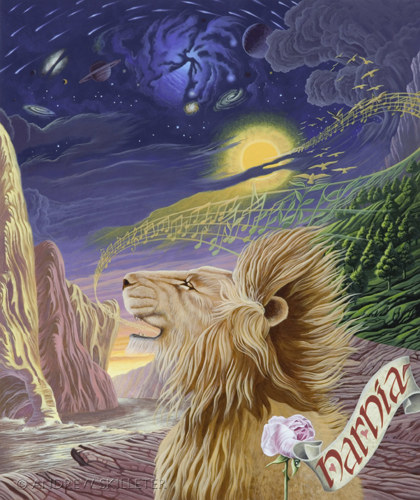
          A most beautiful sequence brings forth Narnia as a place. It starts, as in Genesis, as a void. Then Aslan’s voice sounds in the void and stars come, and sun, and water, and landforms, and plants, and animals, and then some animals are given the power of speech. I guess the cabbie and his wife become Adam and Eve, sort of. Narnia forms out of the song of the lion. It is quite ecstatic and I would love to see it animated. The rendering at the right does not do it justice.
          Digory becomes the old professor in LWW. He built the wardrobe from the wood of the apple tree that grew from the core of his mother’s apple. The wood of the wardrobe has Narnia in it. So, there are no loose ends in this series. Adding this book to my repertoire completes my knowledge and increases my appreciation of these beautiful books.

Tuesday, June 5, 2012

Redwall Abbey Series, by Brian Jacques

Redwall Abbey: To mouse scale, so a mouse would be the size of a human
in this setting. The abbey is surrounded by Mossflower Wood
Color these books "Beatrix Potter Meets the Third Reich." I read the following eight books in the Redwall Series, by Brian Jacques:

  • Martin the Warrior
  • Mossflower
  • Mariel of Redwall
  • The Bellmaker
  • Salamandastron
  • Redwall
  • Mattimeo
  • Rackety Tam

     It has taken me ten weeks to read these eight books. I found them to be clever, but laborious--excessively detailed in all of the wrong places. Jacques wrote more of these books; I am thankful they were not on the list.
Legendary Martin the Warrior
     The Redwall books are set in a fictional forest called Mossflower Woods, which holds the magnificent and strong Redwall Abbey. The abbey is a place of health, help, and healing, occupied by monastical brother and sister mice, as well as numerous other small mammals. Badgers and wolverines are the largest sentient critters; field mice and "Dibbuns" (babies) are the smallest. Birds are sentient. Insects and fishes, no. You can't eat sentient; you can eat fish. Although the abbey is presented as a place of peace and its inhabitants offend no one, the abbey is constantly beset by evil. The abbey itself is attacked in every single book.
     All of the characters in the Redwall books are small mammals of the British woodlands. In the first book, a horse appears, but from then on no hoofstock appear. In two books cats are characters. Otherwise everyone is a squirrel, mouse, vole, mole, otter, badger, shrew, toad, rabbit, hare, fox, rat, and the above-mentioned wolverine. There are several kinds of birds. There is no chipmunk--is that an American animal? Also no skunks, although a skunk would be a formidable weapon. The wittle amuhmuls are just too cute, wearing little clothes and eating quaint foods.
The evil rat Cluny the Scourge
     I had a hard time relating to any of these little furry treasures, but I am definitely not the demographic for these books. I can imagine that if you feel overly small and powerless yourself you might identify with a mouse who becomes endowed with great warrior skills and powers and a magic sword and all that. I think that precocious skinny fifth graders with big glasses and no sign of body hair in the foreseeable future would lap up these books like an evil kitty-cat laps up leche.
     I was troubled by peculiarities of scale. If I stood next to Redwall Abbey, would it come up to, say, mid-thigh? Or is everything scaled up so that the mice people were really 5 feet tall and I could easily shake hands with them? How high were the trees of Mossflower Wood? They were not specified as tiny trees, yet the critters interacted with them as though they were scaled down oaks and maples and apple trees. Was there a human-sized world somewhere? What would happen if a human found Redwall Abbey? Finally, I had to just let go of anything related to scale, subsisting in a sort of logistical limbo. And, of course, I was overthinking everything because I was unengaged. I did not relate, so I tried to compute. And computing didn't work either!
Badger--good
     The plots and themes were utterly simplistic--good versus evil. Evil foxes and rats kept trying to take over the abbey. It was creepy how the slaughter of the good by the bad was portrayed as evil and craven, but the parallel slaughter of the bad by the good was somehow clean and necessary. The Redwallians never tried to mediate or convert. They resorted to violence and trickery to protect their abbey. The ends justified the means. Whoosh! Off goes a bad rat's head! Yippee! Score one for the abbey side. Characters were also all bad or all good. Redwallians might have quirks and foibles, but their hearts were gold through and through.
Fox--bad
    The villains, however, were evil incarnate. Every villain in the nine books I read was a carbon copy of the others--a brute who ruled by coercion and violence, the typical schoolyard bully. He or she was always portrayed as brilliant and cunning, but somehow good is smarter than evil (a common convention of science fiction and fantasy literature) no matter how smart evil is. The villains were quick to kill, slow to think. I suffered from reading these books so close together. It was like that bad guy with the deadly hat in Goldfinger or Gollum in LOTR who kept coming back from what you thought was sure death. These bad foxes, rats, wolverines just kept coming.
The squirrel hero Rackety Tam
     So, although these books were lush and long, they came across as shallow and stilted. Both the villains and the heroes were tedious, especially in light of the obviously foregone conclusion that the abbey would prevail. I can almost hear "Onward Christian Soldiers" in the background. Curiously, the abbey was absolutely not portrayed as Christian. The spirit of the great warrior Martin watches over the abbey, but even Martin is not particularly deified. Critters consult him, but they don't pray to him. The order of monks (male and female) who ran the place were nature-based and one of the saving graces of the books were the many ways to say grace in a nature-oriented way. Here is an example:
Fate and seasons smile on all,
From sunrise to the dark nightfall,
This bounty from both earth and tree,
Was made to share, twixt you and me.
To Mother Nature let us say

Our thanks, for life and health this day.
Verses, poems, and songs were plentiful and pleasing in all of the books, although I started skipping them after awhile, just to get the pages to turn faster.
Redwall food is so well-detailed that
you can cook it yourself at home!
     The abbey critters had an absurd interest in cooking, talking about, and eating food, and Jacques' imagination certainly had no limits. Huge feasts were described in excruciating detail and did virtually nothing to advance the plots of the books. I started speed reading through these, too, to somehow find some action. And when I did find action, it was always fighting and killing. These books are basically one huge neverending battle scene. And the detail is gruesome...heads rolling off...guts falling out...spear through the throat...and that's just the stuff the good characters did!
     I was troubled by the utter lack of compassion of the Redwallians. They felt little or no regret at taking lives in battle. They were unable to relate to the bad guys, to even imagine walking in their shoes. The bad guys were pre-labelled, their fates inevitable. This is how you gear up cultures for war--dehumanize the other side (and in this book, no one is even human to begin with!).
     In conclusion, if you like these books and they do something for you (or for the kids who read them), then I'm OK with that. I can see that they might assist in empowering the weak. But as an adult I found the Redwall series boring, simplistic, and slow. I don't particularly recommend them.

SIDEBAR: Is It Quest Literature?

     The Redwall books have most of the elements of quest literature--untried heroes and heroines going off to discover gifts and dangers, fighting for the right, and maturing into true adult warriors. (All true adults are warriors, I assert.) But the absolute lack of tension in these books makes one hero journey after another meaningless. We know exactly how the book will end from the very beginning.
     For the hero journey/quest to succeed, the element of peril must be full and robust. There should be some fair chance of defeat (have you seen "Rise of the Planet of the Apes"?) (were you worried that Luke might go over to the dark side?) (what about when Frodo turns to Sam in the belly of Mount Doom and says "No, it's mine, my own"?--that's a hero in serious peril). The Redwall books resemble video games more than they do quest literature.