I was surprised to see that in this response to Burnett's Little Lord Fauntleroy I cited Dickens, as I did many months later in my response to her A Little Princess. Dickens' child characters are not nearly as sentimental as Burnett's--he moves from the personal story into the sociological and the metaphysical. But both portray some pretty harrowing ordeals for young people and give them due credit for responding to those ordeals. The children are not paper cutouts.
Here is my response:
Little Cedric, a charming boy living in working class neighborhood in New York City in the approximate 1850s, is discovered to be the sole heir of an English Earl. He is plucked from his happy life and becomes equally happy in his new life. There are plots twists here and there, but the core of the book is in the relationship between Cedric and his grandfather.
 The
grandfather is hardened, self-serving, and disliked. Cedric, though, sees all
through his own eyes, and asserts the essential goodness of grandpa. Grandpa’s
transformation is both sweet and unsentimental.
The
grandfather is hardened, self-serving, and disliked. Cedric, though, sees all
through his own eyes, and asserts the essential goodness of grandpa. Grandpa’s
transformation is both sweet and unsentimental.
Here is my response:
Little Cedric, a charming boy living in working class neighborhood in New York City in the approximate 1850s, is discovered to be the sole heir of an English Earl. He is plucked from his happy life and becomes equally happy in his new life. There are plots twists here and there, but the core of the book is in the relationship between Cedric and his grandfather.
I was surprised that this was such a delightful book. The excessive sweetness and virtue of the title character, Cedric, Lord Fauntleroy, was well balanced by wry wit and dry asides from the author. The boy Cedric’s golden character transforms the lives of all who come in contact with him. He is not trying to rescue, but his very self is enough to work wonders.
The book is funny and well paced—as fast as you always wish a Dickens book would be. The writing was fine. Clashes between working class folks (American and English) and the aristocracy were well drawn. There's a great joke about U.S. Independence Day not being celebrated in England.
As with the book Black Fox of Lorne (see earlier post), England is presented as a cultural paragon. Even the crusty shop owner from New York City goes to live in England without a backward glance. And Fauntleroy, while asserting his American-ness, submerges wholly in upper class English life and doesn’t look back.
I enjoyed this book. I don’t know if I’d recommend it
generally to today’s children, but it holds up well as a genre book from its
own time.
 Burnett was born in England and split her adult life between England and the United States. She was a socialite, fashion-conscious, and wrote books to maintain her lifestyle through her own earnings. And, she was successful. Her books sold (and continue to sell) well and were filmed and dramatized for the stage even in her lifetime. She started a fashion rage based on Fauntleroy's clothing--lacy shirts and velvet suits and fancy shoes for boys--and on his hair--long, blond, and curled with bangs like a girl's.
I think this is very funny, that her boy was so girlish, since, as I mentioned in my Little Princess blog post, Fauntleroy played a role in his book that is usually reserved for girls.
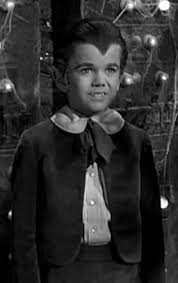
The funniest example of the Fauntleroy look is Eddie Munster. I never realized until reading these books that Eddie was dressed like Cedric in a huge fashion inside joke!
Child-Hero
I wish that I had had more of a sense of heroism in my own childhood. I put it down to a lack of delusion--in a sense, the little princess and the little lord Fauntleroy survive because of the faith/delusion they have that they are part of something serious and important. And studies have always shown that non-depressed people are actually somewhat delusional--they tend to see things through rose-tinted lenses. How to make depressed people re-delusionalized, that's a question begging to be answered.
A young friend told me recently that he went off his anti-depressant medication because the pills made him feel like he wasn't worrying enough--that stuff was getting away from him. He couldn't take the delusion, wasn't ready for it. I thought that was interesting and self-aware. And goes to the issue of resilience. What made Sara and Cedric so resilient? Was it their early awareness of devoted parental love? Was it their submersion in heroic literature? Was it just a literary device to make the plot happen?
Anyway, I could have used some rosy spectacles in my younger days. I was so much older then...I'm younger than that now.
I think this is very funny, that her boy was so girlish, since, as I mentioned in my Little Princess blog post, Fauntleroy played a role in his book that is usually reserved for girls.
The funniest example of the Fauntleroy look is Eddie Munster. I never realized until reading these books that Eddie was dressed like Cedric in a huge fashion inside joke!
Child-Hero
I wish that I had had more of a sense of heroism in my own childhood. I put it down to a lack of delusion--in a sense, the little princess and the little lord Fauntleroy survive because of the faith/delusion they have that they are part of something serious and important. And studies have always shown that non-depressed people are actually somewhat delusional--they tend to see things through rose-tinted lenses. How to make depressed people re-delusionalized, that's a question begging to be answered.
A young friend told me recently that he went off his anti-depressant medication because the pills made him feel like he wasn't worrying enough--that stuff was getting away from him. He couldn't take the delusion, wasn't ready for it. I thought that was interesting and self-aware. And goes to the issue of resilience. What made Sara and Cedric so resilient? Was it their early awareness of devoted parental love? Was it their submersion in heroic literature? Was it just a literary device to make the plot happen?
Anyway, I could have used some rosy spectacles in my younger days. I was so much older then...I'm younger than that now.

