The Betsy books communicate the ultimate American happy childhood of the mid-20th century. Nuclear family, dad working & mom at home, white people only (except for a few servants), traditional holiday celebrations, mild dramas with happy resolutions. The parents are benevolent and infinitely understanding; teachers perky and young; friends loyal. The household pets are the most entertaining and several chapters revolve around animal escapades. Betsy's friend Billy's dog is always getting something sticky dumped on him or rolling in something and the kids' efforts to clean him up always add to the mayhem. Read the chapter where the bottle of molasses gets knocked over and drips all over the dog. Another time it is pancake batter.
I delight in the fact that these books (except for their utter blissfulness) are written for children, not for adults reading for children. When you are a kid, you don’t think of your life in a story arc. Breakthroughs rush toward you like waves on a beach. I think kids would really like this book. And, I reflect, adults only pretend to see their lives as having a story arc, or see the arc in hindsight and over-interpret it. The analyzed life is not the norm—it’s only the norm among book readers and writers, I think. The book readers and writers create and perpetuate a weird norm and then think everyone lives like we do!
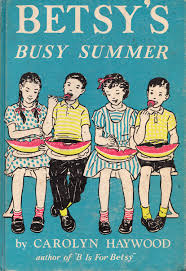
In other books, Betsy has a watermelon party,
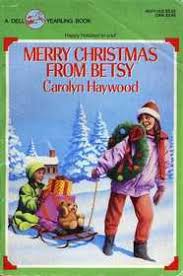
takes a sleigh ride with Santa, enjoys various mild crises that her mild
parents always turn into gentle learning experiences. Things work out for
Betsy. Wrongs are righted, disappointments redeemed. The saving grace of these
otherwise insipid books is the humor. The episodes are comic and the responses
are variously stupid and clever (with mom and dad always ready—with the garden
hose in some cases).
 In addition to the element of humor, Haywood's characters are fun and likable. Although the books as a whole are pretty goody-two-shoes, the children themselves are not. They develop jealousies, make mistakes, misunderstand each other, and have the occasional hissy fit. In one book, an angry boy plays a prank on Betsy. She thinks Billy did it and starts to shun him. The crisis is resolved gently and all is forgiven. The lesson given was that you should judge by what you know about a person, not by a single incident...pretty mild. Still, the children came through as authentic--children you'd like to know.
 I am concerned, though, that Betsy's world is so well
drawn that kids might think it is how life is or should be. As amusement it is
great, but as reality it is a bit ridiculous. Not all boo-boos (of the heart as
well as body) are so easily healed or healed at all. Still, I am eager to be
amused by more of the books in this series as soon as I can find them. And, the children's books that try to incorporate realism don't always work...I can easily view the Betsy books as as kind of fairy tale, fables, inculcators of community pro-social values. In that sense, they truly do their work.
I am concerned, though, that Betsy's world is so well
drawn that kids might think it is how life is or should be. As amusement it is
great, but as reality it is a bit ridiculous. Not all boo-boos (of the heart as
well as body) are so easily healed or healed at all. Still, I am eager to be
amused by more of the books in this series as soon as I can find them. And, the children's books that try to incorporate realism don't always work...I can easily view the Betsy books as as kind of fairy tale, fables, inculcators of community pro-social values. In that sense, they truly do their work.
A Betsy Bibliography
I used a patchwork quilt of sources to put together a sequence of the Betsy books--many of the books have been re-issued, so they have multiple publication dates. To the best of my effort, the Betsy books include the following:
"B" Is for Betsy--book 1, 1939
Betsy and Billy--book 2, 1941
Back to School with Betsy--book 3, 1943
Betsy and the Boys--book 4, 1945
Betsy's Little Star--book 5, 1950 (found 1959 also)
Betsy and the Circus--book 6, 1954
Betsy's Busy Summer--book 7, 1956
Betsy's Winterhouse--book 8, 1958
Snowbound with Betsy--book 9, 1962
 Betsy and Mr. Kilpatrick--book 10, 1967
Merry Christmas from Betsy--book 11, 1970
Betsy's Play School--book 12, 1977
The Eddie Books
 Carolyn Haywood's other famous series is the Eddie books. The pattern is the same, but Eddie is funnier--he's a bit eccentric, like if you combined Beaver Cleaver and Alex Keaton. My review of these Eddie books from a couple of years ago shows that my evaluations of the Betsy books hold true--likable characters, humor, and lots of animals carry the stories.
 Seven-year-old Eddie’s rascally goat Gardenia gets sent off
to a ranch in Texas—she has chewed up one too many valuable items in the Wilson
household. Eddie goes with Gardenia and is introduced to ranch life. This is a
fun book, if a bit slow. Knowledge about Texas and ranches is placed
didactically in the mouths of characters who otherwise say only, “sure,” “you
bet,” and “howdy.” But the second half of the book is fine, when Eddie sets out
on his own adventure, through which he finally earns his spurs as a real
cowboy.
Seven-year-old Eddie’s rascally goat Gardenia gets sent off
to a ranch in Texas—she has chewed up one too many valuable items in the Wilson
household. Eddie goes with Gardenia and is introduced to ranch life. This is a
fun book, if a bit slow. Knowledge about Texas and ranches is placed
didactically in the mouths of characters who otherwise say only, “sure,” “you
bet,” and “howdy.” But the second half of the book is fine, when Eddie sets out
on his own adventure, through which he finally earns his spurs as a real
cowboy.
 Eddie and his cousin Georgie are enthusiastic and enjoy
roaming the range as much as the cattle, goats, and sheep. The adults are
caring but allow the boys lots of freedom. They hit two major crises—the truck
gets stranded in a rainstorm, and Gardenia must be rescued from a thorn bush.
Eddie and his cousin Georgie are enthusiastic and enjoy
roaming the range as much as the cattle, goats, and sheep. The adults are
caring but allow the boys lots of freedom. They hit two major crises—the truck
gets stranded in a rainstorm, and Gardenia must be rescued from a thorn bush.
 I think the title of this book is a nod to the
counterculture movement of the 1960s and 1970s, when “happenings” began
happening. A school year is the background of this book, and it centers around
a calendar of obscure events that Eddie’s friend finds. They celebrate all
sorts of strange stuff. The book ends in February, with a triumphant winning of
the Washington’s Birthday pageant.
I think the title of this book is a nod to the
counterculture movement of the 1960s and 1970s, when “happenings” began
happening. A school year is the background of this book, and it centers around
a calendar of obscure events that Eddie’s friend finds. They celebrate all
sorts of strange stuff. The book ends in February, with a triumphant winning of
the Washington’s Birthday pageant.
A Betsy Bibliography
I used a patchwork quilt of sources to put together a sequence of the Betsy books--many of the books have been re-issued, so they have multiple publication dates. To the best of my effort, the Betsy books include the following:
"B" Is for Betsy--book 1, 1939
Betsy and Billy--book 2, 1941
Back to School with Betsy--book 3, 1943
Betsy and the Boys--book 4, 1945
Betsy's Little Star--book 5, 1950 (found 1959 also)
Betsy and the Circus--book 6, 1954
Betsy's Busy Summer--book 7, 1956
Betsy's Winterhouse--book 8, 1958
Snowbound with Betsy--book 9, 1962
Merry Christmas from Betsy--book 11, 1970
Betsy's Play School--book 12, 1977
The Eddie Books
Eddie and Gardenia
It’s the relationship between Eddie and Gardenia that
animates and fulfills this book. They are both likable and lively and devoted
to each other. This is the first Haywood book I’ve read. There are many more
Eddie books. I hope to be able to locate them and add them to this list.
Eddie’s Happenings
This book is light and fun. A troubled character, Tookey, is introduced.
He has a hard time with when to pretend and when not to. The issue is handled
very matter-of-factly, which is refreshing in these days of sensitivity
training and self-esteem exercises. Accepting friendship is the main solution.
I enjoyed this. The book ends abruptly, as did the Gardenia book. I wonder if I
read them in order if the time line would be continuous.
Style
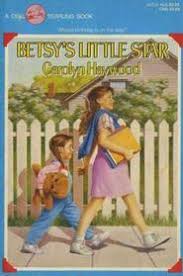
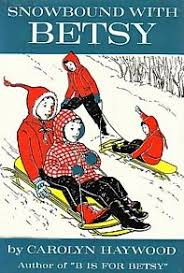
I enjoyed discovering the various covers for the Betsy books. They are a real history of American design. I picked the best image available and didn't try to be consistent. You can see the chubby child images of the forties and fifties giving way to the well-adjusted sixties and seventies child giving way to photography. Interesting.

