Search This Blog

Showing posts with label fantasy. Show all posts

Sunday, April 14, 2013

Among the Ruins of the Kingdom, by Douglas Hatten

A new entry in the fantasy tradition, Among the Ruins of the Kingdom, by Douglas Hatten, is fast-paced and engaging. Although it started a bit slow, I was hooked by about page 50 and after about page 150 I could not put the book down. Hatten is the cousin of my friend Maryjane Ferguson, a disclaimer that means little in terms of this review. If I had disliked the book I simply would not have reviewed it...so I'm happy to recommend this book to you. It's a touchy thing to review a book by someone you have a connection to. I admit that my tendency is to sheath my claws a bit. Enjoy!

The author, Douglas Hatten
Among the Ruins follows a standard quest format--a teenage boy is selected and identified as the champion of good versus evil. He undergoes numerous trials and contests and gathers allies and magical objects. He gains power and skill as he goes along. This is an entirely predictable formula, repeated again and again in all genres of literature and in uncounted movies and video games. Yet, it works. It still works, even when I know exactly what's going on and even when I am certain of the outcome (the hero prevails). The quest format is a comfortable template upon which to build a story and allows the reader to focus on themes and characters.

I pictured Chayim as a young
Leonard DiCaprio
In Among the Ruins, just-turned-17-year-old Chayim is forcibly diverted from his life as a peasant-scholar. His parents were told to send him for schooling because of a prophecy. Among his family and teachers, only Chayim did not know that he had a special destiny. Seventeen is the age of adulthood in Chayim's culture and his adventure starts right on his birthday--a nice touch. On his way home from school, Chayim is stalked by a shadow being and is rescued by a wizened old man who carries a walking stick--the Gandalf character. I don't think Hatten stole the idea of Gandalf from Tolkien--I just think that the wise old teacher is a fixture in quest literature. Tolkien got his Gandalf from a much older tradition.

Here's my favorite cinematic Jesus--Ted Neely
from Jesus Christ: Superstar. What might Jesus
have accomplished with a good mentor like
Gandalf?
ASIDE: It is peculiar that the ultimate quest/savior, Jesus, did not have a mentor...or his mentor was lost in the retelling. So much of quest literature is based in Christianity...somehow the mentor character survived his/her exclusion from the Christian story. The disciples were clearly subordinate to Jesus, not advisers or teachers. I'm not a Christian scholar...are there versions of the Jesus story that indicate a mentor? In a sense, I guess his dad was his mentor, except maybe without a walking stick. Please comment if you have feedback on this.

Aragorn had a romance--and a hot French
kiss you can see if you watch the scene in
super slow-mo. Lucky couple!
Anyway, when the mentor, Zidek, rescues Chayim, the adventure begins. Chayim, with the help of various friends and powers, must somehow collect the armor of a great king, which will allow him to prevail in a great battle between good and evil...and bring back the great king (a reference to the second coming of Jesus?) and a time of peace. I will not go into the plot here--don't want to risk any spoilers--but danger, courage, discouragement, betrayal, violence, victory, and love are a part of it. We watch as Chayim grows into his hero role. And, a romance is provided for him, which makes him a tad luckier than Jesus and Frodo!

A thick forest is one of the memorable locations
of Among the Ruins
Hatten presents a coherent worldview for his fantasy--a set of sacred texts, spiritual practices, initiates and intiators. The history of the kingdom is fully present in the present, which is a nice thing. As a reader, I had a strong sense of Chayim's heritage and traditions. This increased the plausibility of the book. The sensory detail was sparse--a polar opposite from Tolkien--and yet I had a physical sense of place. And certainly after Chapter 1, I was fully engaged in this world and retain it as a place I have visited.

The main philosophical question in Among the Ruins seemed to be the conflict between predestination and free will. The author worked hard to reconcile these two ideas...repeatedly and often. Several times, Chayim questions his role in the drama...does his free will mean anything at all in the face of living out a prophecy that was written millenia ago? The issue is not resolved to my satisfaction, but then I am a free will sort of person. I don't believe that "it is written" until I've written it.

My favorite scenes were those in which Chayim felt the pull of the power of creation. In a Joseph Campbell sense, he was open to allurement and followed its energy. Anyway, when the pull started, I knew something amazing was going to happen--an amazing dragon, a display of superhuman powers, some sort of magic. I loved that. And I loved the idea of ancient portals--short cuts--that would open if Chayim would synchronize with the power.

My main problem with this book is that it could use a good copy edit. I'm pretty fussy about grammar and spelling and usage and such, and maybe I'm just old-fashioned. But one of the reasons I would like a major publisher to pick up and publish this terrific book is that they would give it a serious structural edit and a copy edit. I came across "parameter" used for "perimeter" (twice!), and "its/it's" used improperly, and "suites" used for "suits,"  and many other bits of carelessness. I think a good editor would also pep up the opening chapters of the book and jump the reader right into the action.

I will be buying book two of this series probably today. Why don't you go and buy book 1? You'll find it for sale at:
http://www.lulu.com/shop/douglas-hatten/among-the-ruins-of-the-kingdom/paperback/product-18837230.html

Friday, January 20, 2012

The Lord of the Rings: The Return of the King, by J.R.R. Tolkien


Tolkien's Lord of the Rings: The Return of the King is the third book in the Lord of the Rings trilogy and the fourth of the books set in Middle Earth.

Once again, I was drawn into Middle Earth as if it were a real place, one that is now part of my personal and historical past. It is as compelling as Camelot or Shangri-la, and other "lost time" fantasies. And much more.

There is such a gritty reality to the Rings trilogy. Nothing is clean in this book--all are tainted by the bitter fumes of the dark lord. Light is fading in almost every regard: the sky is darkening; people move through foul caves and tunnels; people subsume their identities in disguises; in this book, all are moving toward the final war against the Eye. Frodo can no longer see the Shire, can no longer remember the taste of bread or the smell of new-mown grass in the fields.

The lost city of Shangri-la
Frodo and Sam face gruesome, soul-wrenching ordeals as they stagger toward Mordor bearing the weight of the ring--Shelob the spider, orcs, the creature Gollum, Nazgul, heat,  starvation, molten rock, and the utter hopelessness of their quest. Pippen waits with Gandalf at the doomed city of Gondor, watching insanity spread as the enemy gathers its forces. Merry rides with the Rohirrim, but disguised and in secret with Eowyn, riding toward war and certain doom. All of his friends are fighting. He must fight for them. Aragorn, Gimli, and Legolas take the pathways of the dead…Aragorn’s faith in himself is tested; he is royal or he is dead. And, if the dead do not follow him, the war against evil is lost.


The most moving part of the book, to me, comes after the battle of Peleanor, when it is clear that the titanic battle that was a grueling victory for the West was a mere skirmish for the Eye. His forces are vast and he will defeat the good, if battle is the method of attack. The forces gather in council. Should they strengthen defenses and die in a few months, or ride out to the attack now and die quickly, Aragorn asks. In this state of hopelessness, the council decides to have faith in Frodo and Sam. If men will be wiped out, they will be wiped out creating a distraction that takes the Eye away from Frodo and the ring, which are secretly in Sauron's very stronghold. Aragorn's men agree to sacrifice their own lives for the future of all. This is a decision of great beauty.


An image of Camelot
This book was full of fear and battle, wounding and battle. The way Tolkien sets up the victory at Pelannor and then snatches it away made the doom so much more real. I felt a glissando of sheer terror at that moment, horror and loss. And I felt all the more resolute when Aragorn led his army into action and into certain death. I was right with them.


Yes, the Rings books are more in the endless procession of guy-bonding books that so fill the fantasy and science fiction genre. In this book, Eowyn is the only woman who has any role whatsoever--but her character is fully developed--more so even than in the movie. She channels her heartbreak over Aragorn’s dismissal of her love into valor. And her role is essential to the victory—her killing of King Angmar of the Dark Riders is marvelous symbolism and drama. And then she gets a wonderful gentle romance with Faramir in the Houses of Healing. I loved that. She must come into her true power before love can enter her life.

Middle Earth
But the Halflings are the true heroes of the story. Their courage, loyalty, wit, and charm are terrific. They are more fully developed for me now that I have such a familiarity with both the movies and books. They show that danger, fear, hunger (and the unknown in general) only strengthen the pure in heart. In fact, that is the hero journey for most of the principal characters--good and bad. How will you respond when the rug is jerked out from under your life, when the feces hits the fan, when you are truly and utterly lost? What will guide you through the dark? What is your light of Elendial? The characters of these books will show you many different strategies for coping. And they demonstrate courage over and over.


I had to include at least one photo of Viggo Mortensen as
Aragorn, the returned king of the title.
I highly recommend Tolkien for junior high school age and up. They are truly beautiful and rich. However, not everyone can read fantasy, so you don't "have" to read them and you don't "have" to see the movies. But, please, at least once, give them a try.

As soon as I finished reading the Tolkien titles on my list, I started reading books by Mark Twain. Switching over to Tom Sawyer has given me mental whiplash. I switched from the sound of ancient sagas being told by candlelight to Twain’s tall-tale-teller voice. I can almost hear him chuckling at his own wry jokes. Still, Tom Sawyer is also a quest story, and holds up well in that genre in its own way. Frodo bearing the ring and Tom bearing the pansy…hmmm.


There's some weird stuff out there. For sermons and essays on LOTR, try:
www.sermoncentral.com/sermons/the-lord-of-the-rings-sermon-series...

http://www.gradesaver.com/the-lord-of-the-rings-the-fellowship-of-the-ring/study-guide/

Thursday, October 27, 2011

Swiss Family Robinson, by Johann Wyss, circa 1889


Papa contrived a boat of cut apart barrels--this illustration is close to how I imagined it.

Sometimes a book combines with what is going in my life to double its impact. Such was the case with Swiss Family Robinson, by Johann Wyss. The Robinsons’ unceasing earnest industry in surviving the shipwreck that left them stranded on an island matched the serious frenzy going on in my own life as my co-workers and I struggled to establish a new jobs program in three different communities. We (and the Robinsons) could rest, but only for a short time…the work goes on…the work goes on.

My colleagues and I are working toward a specific goal and we expect things to slow down in a few weeks. What’s striking about narrator Papa Robinson, however, is that he keeps working because work itself is a virtue, a human duty. The island is a challenge to be explored, harnessed, controlled, changed, mastered, conquered—and relentlessly. Every animal was seen as a food source to exploit or make use of. Every plant was seen in terms of its uses—beauty was a secondary benefit to the provision of shade, fruit, grain, or fiber. With the energy of the true Christian Soldier, Papa sets forth to bring order and productivity to the chaos of nature. It is a truly 19th century zeitgeist. Man is at the top and he will rule.

Mama Robinson, referred to as “the wife” or “the mother,” supplied endless pots of food from the most exotic of ingredients as if by magic. She never grimaced when Papa and the boys (four of them) brought back something new to cook—like kangaroo meat, shark steaks, penguin, frog, monkey, bison, and bear. She too was inexhaustible in her energy, grinding manioc root into flour, making cloth (and food) from scratch, planting, reaping, and sowing (as well as sewing). Mama and Papa have a cooperative  relationship—in a few sweet scenes, they wake each other up before the boys to…no, not that…talk over their plans for the day, so as to show a united front. In another obscure item, Papa seems to reveal that he sleeps in his own room. Perhaps the Robinsons concluded that adding to their shipwrecked brood would cause hardship, although they took in baby animals of all sorts (to tame for use).

We only see Mama through Papa’s eyes—we see his view of her and of everything. Is Papa a reliable narrator? Has he glossed over the truly gruesome predicament that has befallen his family? Is everyone’s incessant good cheer and enthusiasm more what he wants to present to the world than what he actually experiences from his family?

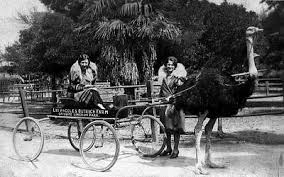
I am going to default on this question, because it simply does not matter. This book is not serious. It is a somewhat sober tall tale, like Paul Bunyan if he had been brought up properly. The stories are preposterous and implausible, but terrific fun. I kept reading to see what wrongly situated animal or plant they would come across next, what invention would come from Papa’s fertile mind, what new landscape might appear on their infinite island. And, what animal would they tame next? (The ostrich trained for the saddle was a bit too much for me.) The book rollicked all over the place—all with hearty enthusiasm.
 
I guess training an ostrich is more plausible than I thought--this was not the only photo of domestication.

The introduction to the book, in fact, points out that Wyss told these stories in endless variations to entertain his children. One of the children gathered up the stories into a collection, which was then translated and re-translated until this semi-seminal English version was published and became the standard for the English-speaking world. (Note how favorably the English are presented at any mention of them in the book.) So, a narrative structure was actually imposed on the story, like chaining together the Paul Bunyan stories with an artificial narrative. So, please don’t take this book too seriously and try to have it make sense. It just won’t.

I also came to view this story as a fantasy. I thought of it in terms of the fantasy a desperate person might spin if faced with loss and death—as in a shipwreck. I imagine Papa, hungry, having lost everything, spinning out this one last fantasy in which all his sons survived and thrived; food was infinitely available; Mama was by his side; imagination had no constraints. I liked this perspective, but it’s just something I made up myself.

Papa’s philosophy (added, perhaps, some years after Wyss told the tales) is summed up in a paragraph in the final part of the book: “...my great wish is that young people who read this record of our lives and adventures should learn from it how admirably suited is the peaceful, industrious, and pious life of a cheerful, united family to the formation of strong, pure, and manly character.” What Victorian could argue with that?

I recommend this book highly—not as a moral tale of sober survival, but as a series of romps in a fantastical landscape. There are lessons to be learned, but please keep them subsidiary to the fun!
Go to www.tcm.com and enter "Swiss Family Robinson" in the search line for an interesting and funny article about the Disney's filming of this story.