Search This Blog

Showing posts with label Dr. Seuss. Show all posts

Tuesday, May 26, 2015

Shrinklets--A way to summarize

My sister Robin is taking a class to renew her teacher's certification in Virginia. I'm working through it along with her. The teacher introduced her to the form called the shrinklet. A shrinklet helps you get at the key points of a piece of writing. For fiction, it might include the traditionals: setting, characters, plot, theme, and so on. For non-fiction, it might include key points, overall presentation, and purpose.

First, you write a short summary of what you read. Then you pick from the summary to write 5-6 rhyming couplets about the piece.

Robin challenged me to do a shrinklet of a book. First I chose Dr. Seuss's The Cat in the Hat, a favorite of mine that I have memorized visually and textually. Here it is:

The Cat in the Hat ShrinkletImage result for the cat in the hat book
The Summary
In The Cat in the Hat, a strange visitor enters the lives of two bored children who live in an ordinary house in an ordinary town. The Cat breaks all the rules the children have learned, leaving them both horrified and marvelously entertained. His cleanup crew, Thing 1 and Thing 2, take care of the mess with zany energy and machinery, just before mom gets home. Everything is as it was, except perhaps the imaginations of the children. Growth doesn’t come through sameness.

The Shrinklet
Ordinary house, ordinary town,
Ordinary kids, feeling a bit down.

In comes the Cat, the Cat in the Hat
He make dizzying disorder—how about that!

Mom’s on her way home, what will we do?
Cat has the answer, Thing 1 and Thing 2.

All is now clean, well-ordered, the same,
No sign at all that Cat in the Hat came.

But chaos once loosed set the kids free—
But we won’t tell Mom, we won’t, will we?

Tidy and ordinary is more than a bit of a bore.

Now that we know there’s so much-much-much more.

Robin liked it, but we both thought Seuss was a bit too easy, so to explore the shrinklet further, I did Austen's Pride and Prejudice, which I've read as many times as The Cat in the Hat. I realize the key feature I forgot to use was the absolute beauty of Austen's grammar and punctuation. I'll try to add a couplet about that.

Pride and Prejudice Shrinklet

He emerges from the pond and thereafter she admires his "house."
The Summary
Elizabeth Bennett and Mr. D’Arcy. Jane Bingley and Mr. Bingley. Lydia and Wickham. A tangled skein of misunderstandings, cross-purposes, lies believed to be truths, truths believed to be lies. And that terrible Mr. Collins. A cast of memorable characters well drawn. All around the getting of husbands and the traps and lures attendant thereupon. Jane Austen has the most superb punctuation and grammar of any author; it’s like reading art. Balls and stiff formality. Singing at the piano. I have read this book at least 10 times and continue to love it. The tension of wondering whether Elizabeth and D’Arcy would ever both be ready to love each other at the same time pulls the reader through. Oh, and that memorable scene when Elizabeth sees D’Arcy emerge from swimming the pond, his clothes all plastered to his well-formed body…and she then starts to compliment his marvelous "house." 

The Shrinklet
The class struggle imperils the romance,
Leading D’Arcy and Elizabeth a slow dance.

But after D’Arcy emerges magnificently from the pond
Elizabeth admires his "house," which goes far beyond

The love-sickliness of Bingley and Jane
And the calculations of Lydia, so vain.

Pride and prejudice both must give way
For true love to blossom and triumph o’er the day.

Hearts and minds in balance—it’s this
That guarantees Lizzie’s matrimonial bliss.

[added couplet]
Reading Austen is absolutely no chore.
Her grammar and punctuation are really top drawer.

Friday, February 22, 2013

Children's Poetry Collections

The books I read were Favorite Poems Old and New, Selected for Boys and Girls by Helen Ferris (1957); Poems to Read to the Very Young (1982), selected by Josette Frank, and A Child's Garden of Verses, by Robert Louis Stevenson. Many Stevenson poems were included in the other two collections.

For the most part, these poems bored me out of my mind. I was reminded of when I read every Sherlock Holmes story one after the other. Individually, they might have been caviar, but consumed all at once they were more like Spam. They tended to be pretty insipid, reflecting the sweet-rural-innocence view of childhood. I longed for Shel Silverstein, with his gulpable caviar, or Dr. Seuss with his tasty confections.

The Ferris book was huge--567 pages of poems and more than 40 pages of indexes and credits. The book's average of two poems per page added up to more than 1000 poems. The poems were nice enough and some of them excellent, but most were bland. Roughly half were poems from "real" poets like Stevenson, Dickinson, Hughes, and so on. If I had children to read to, this book would be a useful resource, I think, and would certainly introduce some grand formal language.

I was frightened by the fact that the world of this book is completely gone. Today's young don't do the things the kids in the poems are doing, roaming freely through the out-of-doors, staring around in wide-eyed wonder, watching plants grow and cheerful birds pull worms from the ground. Kids don't occupy their own charmed world, and I'm sure they never did, but this vision of bucolic, mild, gentle children has deeply persisted.

I've written before of the odd prevalence of agricultural and gardening imagery in children's literature, even though the agrarian era is completely past. Whenever children see where vegetables are grown or cattle are raised, for example, it's always in a small garden or on a small farm and the cattle are cheerful even though heading to slaughter. Milk comes directly from the bucket to the table. The Ferris book is actually more balanced than the other two because it has more of an academic slant. It includes selections of Shakespeare and beautiful quotes from the bible. The 23rd psalm is in the book. But this tome is culturally archaic and I say this sadly, not sneeringly. It tells me we really need more Shel Silversteins and Dr. Seusses to speak to our modern children of modern times. The Pokey Little iphone. Three little pigs crying "Wii, wii, wii" all the way home. Let's write for the kids we've got, not the kids we wish they were.

The Frank book is insipid. Most of the poems in this book were also in the Ferris book. I thought that by 1982 we would have been a bit more culturally advanced, but the illustrations in this book show rural small town life (a few city scenes thrown in) with every child but one being white. I don't know how that one black kid got in there on page 15. There is also one illustration of "children of the world," with appropriate stereotypes--looked like the art was from 1962 instead of 1982.

Again, the poems in the Frank book would not hurt a kid, and added to a bedtime story would be beautiful. But it might benefit your children to have more up-to-date selections available.

A Child's Garden of Verses just makes me barf. Coy. Precious. Soft-soaped. Sentimentalized. I know Stevenson is famous for this book, but I can't stomach it. As with the Frank book, it's probably not harmful, but I don't think our children 200 years later will relate to it.

Earlier in my reading list, I read a baby book of little poems and they were quite nice, small poems written directly for small children. Here is my review of three books by Kay Chorao, including The Baby's Bedtime Book.


Kay Chorao's The Baby's Bedtime Book is a collection of poems for babies and toddlers, with big, thick, cardboard pages. The illustrations are beautiful and the poems are sweet. They are focused on woodlands and farm life—so prominent in the experience of today’s kids. If you share this book’s idealized vision of babies, you’ll love the poems, too. And, really, they are repetitive and gentle—good for calming babies in preparation for sleep.
 
I also picked up two other books by Chorao. Pig and Crow is a funny picture book about a lonely pig. I liked the fact that the pig got tricked over and over by the crow, but came out happy in the end. Kids learn about growing plants and hatching birds—what you see is not what you get—a little seed turns into a big pumpkin. A small egg turns into a fun goose for company (not dinner). All good. I think little kids would enjoy this book.
 
Little Farm by the Sea takes you through the life of an idealized family farm—one where they grow and raise just about everything at once. The book moves through the growing season from early spring plowing and planting through late fall harvest. The romance with our rural past continues. Are young people really able to relate to this? In the time of Dora the Explorer and ipods? I thought this book, though beautiful, was pretty boring. It was way more didactic than Pig and Crow in presenting the cycle of life.


Friday, April 20, 2012

Reflections of a Blogger on Blogging

The author at her "day" job
I'm Joy Dickerson and I'm a kid's lit blogger. I've been a kid-lit junky my whole life and I love it. No apologies. Blogging about kid's lit gives it shape and form for me and strengthens the bond. I appreciate my readers.


Children's literature is an all-or-nothing type of love. I love children's literature and enjoy sampling broadly in the various genres. But if you don't like children's literature, POOF!, it doesn't exist for you. You can go decades without thinking about it until some particular title goes viral among the young and you see it everywhere--like Harry Potter and Hunger Games. You're now aware of it, but you still don't read it. Well, I do read it.


Two major themes I monitor in the material I read are gender roles and the hero journey. I'm always looking for books in which all characters may properly develop their potential independent of societal norms--and they are few and far between. Even the vaunted Hunger Games can't figure out what to do with Katniss's sexuality--and she's a great character. It's fun in the Hunger Games trilogy to see the men's lives revolve around Katniss and her instabilities.
One of the best adult books
I've ever read.


The hero journey is wonderful to track. Even lame books can have great evocations of the hero journey, or the movement through certain rites of passage to true adulthood. The hero journey subtext is one of the elements of children's literature that draws me back again and again. And it is pretty much lacking in most adult literature.


And I can vouch for the fact that people lacking idyllic childhoods can retain a love of children's literature. We're not all starry-eyed elementary school teachers (like my sister Robin, lol). I know for myself that I still have developmental issues to explore, and children's literature explores them. Would you rather be liked or right? Can a society without individuality succeed? What is family? How do you define courage? Are some people expendable? What if there is no happy ending? How do you grow up and still retain a sense of magic? Why do humans do so much suffering? Why are people cruel? Easy to be hard easy to say no...


I actually wonder if children's literature is read more by adults than children. Is it secretly a subgenre of adult literature? Kid's lit is not for the illiterate or faint of heart--it is as filled with tragedy and sometimes the reading level is surprisingly high. Hunger Games is a good example of a young adult novel filled with death, poignancy, and sophisticated structure and language.


One of the best children's
novels I've ever read
I have been blessed by my Eager Reader's Best of the Best list (http://www.eagerreaders.com). It has included classics like The Count of Monte Cristo, Pride and Prejudice, and David Copperfield, as well as picture books, Dr. Seuss, cartoons, and books aimed at every age of child (including those thick-cardboard baby books). I've also read lots of science fiction, which I love. (Even adult science fiction is really for the juvenile in us all.) The list is skewed, of course, and is a bit long in the tooth. I agreed to read every book on it as a dare to myself--could I sustain this goal over a long period of time? What value would I gain from it. Well, I have gained a huge amount of value...I have put myself in touch with something larger than myself. Blogging has given me a forum into which I may share even the stupidest of my opinions and openly own them. Blogging has brought meaning to my writing. I want to thank my sister Robin and my nephew Jake for the support and prodding that moved me into this adventure, this hero journey of my own.


The Blogging Process


I am more read than I ever was before--957 readings, at the current moment. I know that probably 1/3 of the hits were in error or by non-human entities and phishing schemes, but that still leaves nearly 700 legitimate hits. What does this mean? It doesn't mean I'm popular--many blogs get tons more hits. To some extent it means that my friends and relatives are indulgent and dutifully go to the blog to look at new entries whether they are interested or not. OK, let's take another third off for that. Now I'm at 300 legitamate look-sees. I think that's pretty respectable, given the limited topic (mostly children's and some adult literature reviews) and lack of bells and whistles (still can't figure out how to embed a film clip).


The author at a quilt show.
Blogging is fun. I enjoy the reading, writing, thinking, designing, and researching that goes into each of my posts. I love putting the pieces together. Blogging combines the things I love the most. Most of my blog posts have been positive reviews...I'm more interested in saying what's in the book, what the book brings to the table, so to speak. I will occasionally condemn a book, but that's rare.


I check my blog stats several times a day. The stats page keeps track of number of hits, which post was read, where the hit came from geographically, and where the hit came from on the 'net. As of this writing, I've had 957 hits across 41 posts from every continent except Antarctica (and, unless penguins learn to read, I don't see that changing) and from innumerable and undecipherable Internet sources. I post new blog entries on average of one per week on Facebook and Linked In. I especially love the little map on which the countries turn green if I've had a hit from them and get greener with as hits rack up. I like the "All Time" button--the planet glows with patches of green.


Thanks for reading. Thanks for greening my planet through literature. And keep on hitting my blog.

Friday, March 30, 2012

Favorites by Dr. Seuss (Theodor Geisel)

[I'm sorry this is such a long review.]

Johnny Depp is playing Dr. Seuss in an upcoming
movie--no resemblance yet, but great casting.
Yes, I will use any excuse to include a photo of
Johnny Depp in my blog, even frowny-browed
images like this one.
          I am writing these reviews of Dr. Seuss's books from La Jolla, California, the town in which Theodor "Dr. Seuss" Geisel lived and wrote. It’s a great pilgrimage for children’s literature geeks, also being the home of Frank Baum (author of The Wizard of Oz books). I am happy to be here on an amazing vacation. I can see why Dr. Seuss and Mr. Baum would live here--beautiful skies, gorgeous beaches, endless ocean, mild temperatures--a perfect setting for thinking things up. Books reviewed in this blog entry include Green Eggs and Ham; The Cat In the Hat; The Cat In the Hat Comes Back; One Fish, Two Fish, Red Fish, Blue Fish; Horton Hears a Who; and How the Grinch Stole Christmas.
          A friendly biography of Dr. Seuss can be found at:  http://legendsgallerylajolla.com/bio.php?id=4 You can also find a few examples of his paintings and sketches there (see Addendum). For a better look at the paintings, sculptures, and other works, go to http://www.drseussart.com/.

Green Eggs and Ham, 1960, 62 pages

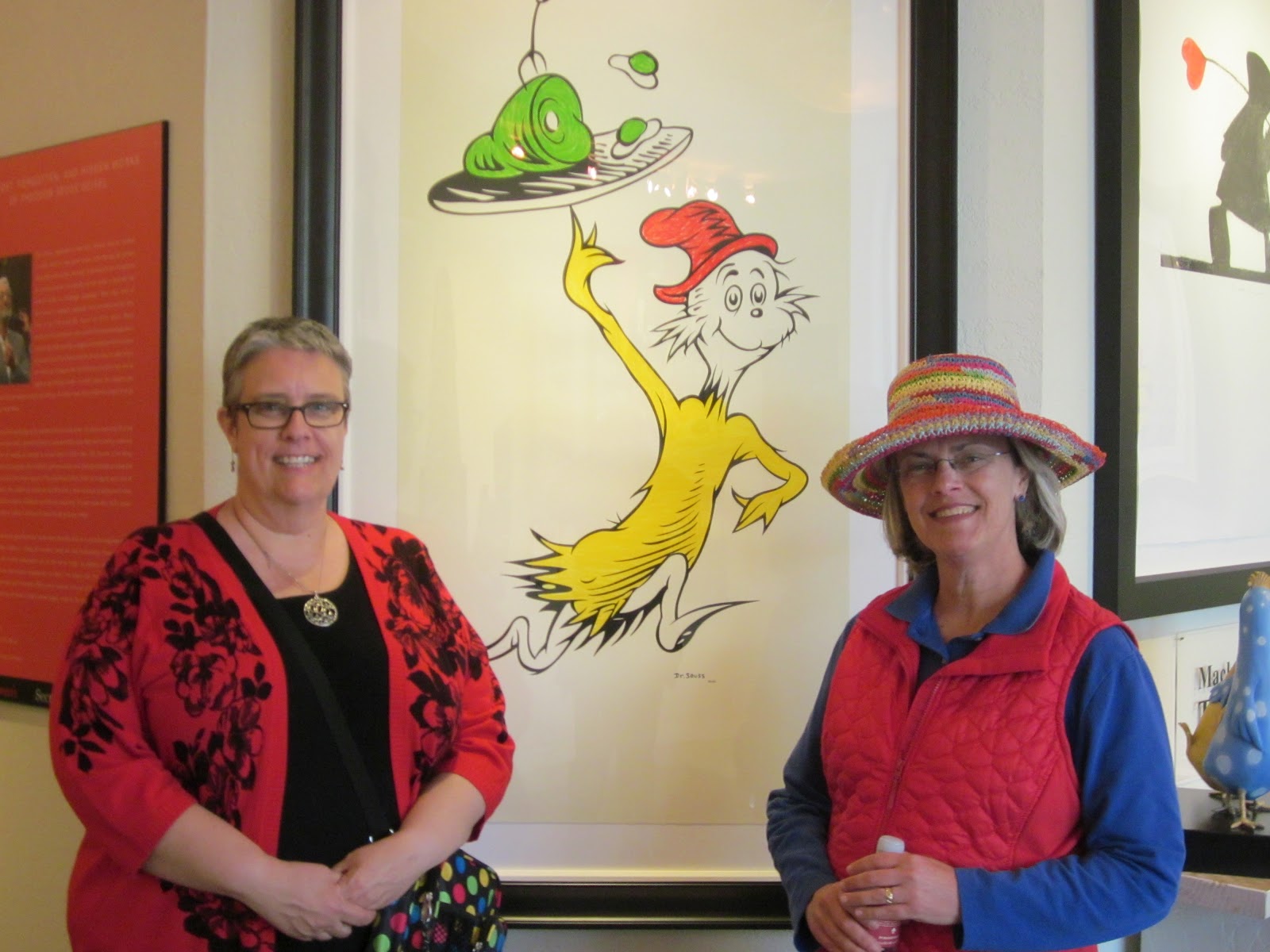
My sister and I at Legends Gallery admiring
their collection of Dr. Seuss's artwork;
they are at http://legendsgallerylajolla.com
          Green Eggs and Ham, which has fewer different words in it than this review--50, to be exact--is a true American classic--and a blast. I was fascinated by it as a child and low these 50 years later I am laughing and fascinated again. The rhyming text is captivating. The repetition of the story elements (in the drawings as well as the text) is somehow pleasing to the brain--I also find this device delightful in certain songs, such as “One Man Went to Mow” and “Hole in the Bottom of the Sea.” It makes me giggle. And this type of repetition probably has roots deep in our past as a memory training device prior to the development of written language. But I’m a book reviewer, not a linguist, so that’s just speculation.
          Green Eggs and Ham also features one of the great Refusers of all times--the unnamed main character. Kids find this character hysterically funny. He’s so emphatic, yet so polite. And kids are always forced to do things they don’t want to do--they are rooting for the Refuser. The twist at the end is pleasing and funny as the Refuser finally gives in and takes a bite. The mood of the book undergoes a sea change as the Refuser overflows with gratitude and you realize that part of you was rooting for Sam-I-Am all along.
          I remember being enthralled by the drawings in this book and how they told the story right along with the text. After I knew the text pretty well I would still look at the book and go over the details in the art. I’m still tickled with the tunnel sequence.       

The Cat in the Hat, 1957, 62 pages

          OK, The Cat In the Hat is my favorite Dr. Seuss book. That darn cat barges in on a rainy afternoon and turns everything topsy turvy. This book, like Green Eggs and Ham, has a concrete and specific vocabulary and makes terrific fun happen from simple words. Taken literally, this is an absurdist text. The door opens, stuff happens, the door slams shut. All is as it was before. Or is it? The child narrator, at the end, is considering lying to his mother. This places the book in on a shaky ethical foundation!
          I think of the stripey-hatted Cat In the Hat that lives inside me. Nowadays, the Cat inside is tamed and mostly under control, but I still have an impulse sometimes to completely TAKE THINGS APART--to completely deconstruct my world. This is another developmental issue for children--how do they become internally civilized? How did my inner Cat get trained? (OK, it was those couple of times I was almost fired!) Also, kids have fits and rages and crazinesses that come over them like thunderstorms or tornadoes. WHOOSH! Then they settle back into their regular selves. The book rings true to me.
          Poetically, the book is solid. Dr. Suess wrote this book on a dare--he could use only 220 different words. The repetitive element in Green Eggs and Ham is fully present, but only for one action stream of the book. When Thing 1 and Thing 2 appear, the book moves into straightforward action. In fact, it almost seems like two different  books smoodged together. (Spell check will not accept “smoodged.”)
          I love this book. I still love the tracking between the 220 words and the illustrations. I love the natural but exact rhyming. I love the anarchy. I love the magical clean-up machine. And I love the sly indication of secrecy. There ARE some things your mom does not need to know.

The Cat in the Hat Comes Back, 1958, 64 pages

          The Cat In the Hat Comes Back is a somewhat disappointing sequel to The Cat In the Hat. Like CITH, this book has two action streams. First, the Cat comes to the kids’ home to wreak havoc on their attempt to shovel the walks at their house. He puts a red ring on the bathtub which proves comically difficult to get out (kind of like a booger on your finger). In the second action stream, the Cat introduces his helpers, Little Cats A through Z, which emerge like nested dolls from under his hat (the hat’s purpose is thereby at last disclosed). The Little Cats introduce an alphabet-book motif and at the same time make more mess. The alphabet Cats make me long for Thing 1 and Thing 2. The narrator character and his sister Sally are much clearer in this book about their intolerance for the Cat’s anarchy and havoc. The whole second half of the book is about the clean up.
          The Cat in the Hat Comes Back doesn’t succeed brilliantly in either of its streams, although the difficulty of recovering from a mistake is certainly authentic. And I can imagine 5-8 year-olds enjoying shouting out the alphabet letters ahead of time, with glee. The illustrations and poetics do not have the zest and wackiness of others of Dr. Seuss's books.

One Fish Two Fish Red Fish Blue Fish, 1960, 63 pages

Seal and pup, La Jolla.
Some of Dr. Seuss's creatures owe their shapes to the seal.
          One Fish, Two Fish, Red Fish, Blue Fish is utter nonsense--and the most fun nonsense you’ve ever read. The world in the book is rollicking and surprising, with one entertainment after another. Meanwhile, lots of  fundamental concept words are introduced, such as color names, numbers, time, basic prepositions, and amounts. The nouns are mostly concrete everyday words.
          I dig this book as much as any child and as much as I did as a child. Made-up words and names and animals appear and the illustrations are somewhat loosened from reality. Great fun.
          I often work on a poem until it is made up primarily of one-syllable words. It makes me boil my idea down to its most basic ingredients. Here are some random examples from my poetry: (1) Let the rain lay in your heart like a lace-edged shield of dew ("Rainveil"). (2) The sky weeps rain ("Persephone"). (3) She slugged it to her slugs with a slug of Big Bear’s best-buy brew ("Choosing Pansies").

Horton Hears a Who, 1954, 60 pages

          Horton Hears a Who is a cultural treasure. The power of one person, in both the macro and micro worlds of the book, makes each one of us immediately important. One person speaking up can change the world. One person adding a voice can change the world. There is a wonderful aura of caring in this book. It’s about being bullied and sticking up for yourself, but depicted instead of preached. And that’s how kids learn best.
San Luis Rey de Francia, north of La Jolla on the coast.
Can you see in the curvy and rounded architecture shades
of Dr. Seuss's wibbly-wobbly Whoville architecture?
Surrealist Spanish Colonial.
          Horton, with his superior gift of hearing, discovers and saves a tiny town on a speck of dust that is about to blow into a pond. No one else in his community can hear the Whos from Whoville, as they inform Horton they call themselves. His macro-world friends ridicule and persecute poor Horton to the point where I was seriously distressed for him. Horton encourages the Whos to band together and make some noise to prove their existence. (All of the Who speech is befittingly set in small type.) One tiny Who puts them over the top. Whoville is heard. Whoville is saved.
           I love the illustrations in this book. The architecture of Whoville and the style of drawing are part of my own aesthetic development. It’s still funny to me to see the Whos doing all the stuff we do, but in a Whoish kind of way--like mowing their grass, tossing a football, sleeping in bunk beds. The pictures manage to be simple and complex at the same time.
          The plot of Horton Hears a Who is compelling enough to stand on its own; the rhyming text serves as a sturdy background element that provides continuity to the action and unity to the whole kit and kaboodle--plot, language, character, theme, art. And the rhyme is Dr. Seuss’s voice, his writer’s voice. It lets you know that he is there and that it is uniquely him.

How the Grinch Stole Christmas, 1957, 50 pages

This surfer statue made me wonder if the
freedom of movement of Dr. Seuss's char-
acters might be related to the popularity of
surfing at La Jolla and other local beaches. 
          Dr. Seuss packed a ton of content into the 50-page How the Grinch Stole Christmas. He must have gotten a lot of mail about Whoville from the Horton book; they are featured in this book as well. It was fun, having read both books within the same hour, to see how Seuss develops the Who world. The Grinch, like Horton, is, should, and ought to be considered one of the great stories of our time. The Whos are filled with peace and harmony (literally, with their singing), so much so that the Grinch’s heart expands. In the classic TV animation, it is physical exertion, not the singing, that works on the Grinch’s heart, but in the book, it is clear that the beautiful singing of the Whos, who have lost everything, is the cause.
          No need to review the plot of this book. Who hasn’t heard it, read it, played it, or seen a version of it? Thematically, Grinch is about love, resentment, and loneliness. It is fun to wallow in the vileness of the villain. We’ve all felt that delicious and terrible urge to take away someone else’s fun, to spoil their happiness. But if the Grinch can change, I hope we can too.
          The key feature of Grinch is language. The rhyming and word play is brilliant and a major contributor to this book more so than in the others in this review. Stuffed the tree up. Roast beast. Cindy Lou Who. Delectable.


          I am so happy that these Dr. Seuss books were on my Eager Reader children’s literature list. I don’t know what else would have gotten me to reread them. And it has been a privilege to read and review them in the town in which they were written. I can see how the potatoesque Who architecture that is featured in many of Dr. Seuss’s books draws from the architecture of the Spanish missions in this area. I can see why he would draw them in the way that he did. I can ‘t wait to learn more about him in the last few days of my vacation.

ADDENDUM: Dr. Seuss as an Artist at Legends Gallery

If you are in La Jolla, locate the Legends Gallery. They have a wonderful selection of Dr. Seuss's paintings, drawings, and sculptures. He did oils and watercolors and bronzes and maquettes. I was stunned by the variety, humor, and excellence of the pieces. I never thought of Dr. Suess as a "real" artist (oh, my snobby self). The picture of my sister and I that goes along with this review was taken at Legends. The people there were very friendly and savvy about the Dr. Seuss works. The other artists on display were also pretty terrific. Legends Gallery is at http://legendsgallerylajolla.com.


SPECIAL THANKS
Special thanks to my nephew Jake Shapiro for solving the problem of how to upload my own photos to my blog. Yes, I probably would have eventually solved this on my own, but why bother with the excellent Jake around?