Search This Blog

Wednesday, July 11, 2012

Chronicles of Narnia--Three

C.S. Lewis on the cover of Time
          The two books in this blog post represent the worst and best (well, tied for first) books in the Chronicles of Narnia series. The first, Prince Caspian, devolves into a bunch of "swell battle scenes," to quote my favorite movie, The Stunt Man. Caspian just doesn't sustain tension and lacks the marvelous imagery that carries the other books...it moves forward the plot, but not the themes. The second book in this review, The Voyage of the Dawn Treader, is absolutely marvelous. The journey takes the children through what is probably the seven deadly sins or something (I didn't look it up--didn't need to validate my reading experience in that way), having Edmund, Lucy, and Eustace experience the pitfalls of human life, and through amazingly imaginative processes. The children are growing up morally as well as physically.


All aboard, now, for


Lewis, C. S., Prince Caspian
          This book is my least favorite of the series so far. It seems somewhat irrelevant to the overall story arc and is pat and episodic. What it lacks is character development. All of the children are flat and static. In the other books, they have struggled with serious questions of identity and self-awareness—in fact, struggled with sin and redemption. Not so with Prince Caspian.
          There are cool moments. Caspian’s story could have made a wonderful book all on its own. He is raised by an uncle who has cheated him out of his inheritance—the throne of Narnia. When the uncle’s son is born, Caspian is at great risk. His wise old tutor helps him escape and tells him the truth of his heritage. He advises Caspian to flee to the Old Narnians, remnants of whom reside in the deep woods. With their support, Caspian might defeat his uncle and bring freedom to the oppressed original inhabitants of Narnia.
          The tutor also gives Caspian the ancient horn of Queen Susan, which he recovered after much searching. The horn calls forth magical aid to whoever uses it. When Caspian’s fortunes are bad in his war with uncle, he blows on the horn.
          Another charming sequence is when the four Penvensie children are pulled away from a train station platform in England and end up on a mysterious island. They have been called by the horn. The island turns out to be the ruins of their former castle, Caer Paravel, and it is fascinating to watch the children put the story together—that although it has been about a year since they were in Narnia, in Narnia hundreds or even a thousand years have passed.
On the platform at the train station, being called to Narnia
         Lucy, Eustace, and Edmund are met by one of Caspian’s representatives and go to assist in the battle. This is where the book pretty much dies on the vine (it’s tomato-growing season here). For one thing, once Aslan appears, there is no doubt about who is going to win the conflict, so the battle sequences are silly. The last third of the book is clever, but not magical. Aslan appears more as deus ex machina than as the benevolent deity (and nudger) we have come to know. I hope this book grows in stature in the overall context of the series. We’ll see…onward to The Voyage of the Dawn Treader. But first, a word from our Sidebar.

Sidebar: C.S. Lewis and J.R.R. Tolkien
          Lewis was famous well before he wrote the Narnia books. He was known as an agnostic who became a believer--and wrote persuasively about the process. The text of a Time article (and for which he graced the cover) discusses this aspect of Lewis's work.


In one of the most intriguing of literary relationships of all time, C.S. Lewis and J.R.R. Tolkien were colleagues and friends at Oxford. Tolkien, an engaged Catholic, strongly influenced Lewis's conversion to faith. You can see in their works the interests that they shared...allegory, metaphor, the conveyance of the ideas of Christianity in settings other than the bible (although I'm sure they distinguished between their own creativity and the bible's divinity), what brings meaning to a story and to people's lives. The fat they chewed over numerous pub pints must have been rich and flavorful. A nice article on this friendship can be found at: http://www.salon.com/2003/12/03/tolkien_lewis/

I have sat at the Tolkien/Lewis booth at the Eagle & Child in Oxford, England, and in a parallel that delighted me, my nephews repeated this pilgrimage a few years ago. Tom and Jake could sit right down with Lewis and Tolkien and join right in the discussions. Me? I'd probably be totally tongue-tied but would write about it eloquently later.

Lewis, C. S., The Voyage of the Dawn Treader
          I loved this book. Lewis is redeemed for the flaws of Prince Caspian. The ship Dawn Treader carries King Caspian (three years into his reign), Edmund, Lucy, and their cousin Eustace far to the east—to where the world ends. Edmund, Lucy, and Eustace enter through a painting of a ship and find themselves floundering in the ocean. They are picked up by the Dawn Treader. Caspian has solidified his kingdom and has undertaken a quest to find seven friends of his father who were ordered to explore to the east (by the bad uncle-king, who hoped they would die).
          The landscapes the group visits are awesome (arouse fear and wonder). On one island, a beautiful pool turns anything that touches its waters into solid gold. The children are swayed by the aura of greed arising in them. They want to protect the pool from others so they can be rich and powerful beyond their wildest dreams. Aslan intervenes and helps them to see the danger and evil of that way of thinking.
Reepicheep sailing to the very edge of east
          On another island, Eustace is turned into a dragon (dragons are the flag-bearers of greed and hoarding). Eustace has been judgmental, priggish, not really a good team player. His dragon experience is transformative of his inner as well as his outer self. Aslan assists him in shedding his outer skins of greed, self-interest, cowardice, sloth. This process is sad and beautiful.
          On yet another island, three of the old campaigners are in a permanent sleep. To wake them, the travelers must go to the very end, the very east, and they must leave someone behind there to break the spell. The sailing to the east is beautifully portrayed. The waters change, the light changes, and in drinking the water the people change. Eventually, the waters are covered with white water lilies (which would be mistaken for snow from above). Reepicheep the valiant rat volunteers to go all the way east, even if it means his death. It is a sad and beautiful moment. He is left behind.
          In Prince Caspian, Aslan tells Peter and Susan that they will not return to Narnia—they have gotten too old. In Dawn Treader, he tells Edmund and Lucy the same thing. He promises to always be with them, but in a different form and in a different name (Jesus/god, I presume). But, it’s lovely.
Lucy interprets the mysterious book in Dawn Treader
          And it makes a case for fantastical literature as a provider of images that children can relate to as a sort of transitional stage between faith in the warm and fuzzy and faith in a god or principle. It’s a very gentle thing, as are these books, dramatic as they may be.
          I do think that this book, in itself, does fulfill the criteria for a hero journey--certainly the children are greatly changed by their experiences and journey through numerous perils and places. And, I had the sense that I, too, had changed. My heart had grown along with my understanding.
          Lewis’s imagination is fully expressed in this book. All of his themes are there—redemption, forgiveness, love, courage, humility—the whole gamut. But the landscapes and locales described are fantastic and fantastical. I yearn to see them myself! The images are lyrical, odd, precious, and amazing.

Friday, July 6, 2012

Chronicles of Narnia--Two


Lewis, C. S., The Horse and His Boy


This picture captures the main ingredients:
Shasta and Aravis, the two talking horses,
and, over all, Aslan
          I enjoyed The Horse and His Boy greatly. It ranged over a large territory and involved enslaved people seeking freedom in Narnia. This book is a hero journey, with Shasta, an escaping slave, seeking his freedom, his heritage, and (unbeknownst to him) his destiny. Shasta faces trials of wit, courage, strength, and faith. His faith he finds through the lion-god Aslan, who he finds out was watching over him throughout his journey.
          Eventually, Shasta and his friends, Aravis (who is running from an enforced marriage to a tyrant) and the two talking horses, Bree and Hwin, find a way to save Narnia from invasion. Queens Lucy and Susan and King Edmund from LWW reappear in minor roles. This is the only book in the Chronicles in which the main character is not a human from outside Narnia.
Rabadash, often cited as a
example of racism in Narnia 
          Aslan is the underpinning of this book and its main tie to LWW. His presence both saves and menaces; his justice is absolute. Even to his enemies, he provides a way out. Rabadash, the invader, is turned into an ass (very funny and apt), but Aslan tells him how to change back. He must publicly pray at a certain temple. Then, he will stay a man unless he goes more than a few miles from the temple. In the wrap-up of the book, he has turned into Rabadash the Benevolent and rules over a time of peace in his land.
          That’s the Aslan way. Aslan is sort of like a warm, soft pillow, but one which will strike out against evil—a pillow with a sharp dagger. He often shows characters how to see the best things in themselves. Wonderful.
          I liked this one. The Narnia magic is working on me. And, I did find the first book, The Magician’s Nephew, so I can go back and catch that one. Interesting. The Narnia books are true fantasy, mythological Christianity, beautifully done, engaging, compelling. I was going to take them on my vacation to Houston next week, but I think I’ll be done with them on this long July 4th weekend. Fun way to spend a long weekend.

Sidebar: Racism and Sexism in the Chronicles
          The Horse and His Boy is often cited as an example of Lewis’s bias toward light-skinned people and against Semitic (Arab) people.  For an interesting treatment of this topic, go to the website Narniaweb.com at http://www.narniaweb.com/resources-links/are-the-chronicles-of-narnia-sexist-and-racist/.
Here's a sultry version of the White Witch,
who is sort of a frosty version of
Galadriel
This writer rightfully points out that prejudice and sexism are almost entirely confined to bad, non-role-model characters and that the focus on a handful of negative images is ridiculous in light of the almost overwhelming number of positive images.
          I do question that true evil in a supernatural sense, as in the “Anti-Aslan,” is represented by women. But gee, it’s a 50/50 chance…if you flipped a male/female coin to decide the gender of the next evil character, you could get all women as evil just by chance! And, as the article points out, this book even features interracial marriage without an eye-blink or comment.
          Lewis's characters—good and bad, male and female, dark and light—are lively and interesting and certainly engaging. Whatever else these books are, they are darned good writing and darned good reading. In my reading in children’s literature for this project, the Chronicles of Narnia are paragons of fair representation.

Lewis, C. S., The Magician’s Nephew

          This is the first book, chronologically, and I had not read it before. In this book, the kingdom of Narnia is founded by Aslan as a sort of Garden of Eden--it is Lewis's creation story (complete with apple). Unwittingly, a human boy and girl bring an evil goddess from a dead world into Narnia, imperiling its future. The children use rings that have also come from an ancient world to move among worlds. The gold rings take you out, usually to a magic woods. The woods has numerous ponds, each opening to a different world. The green rings return you to the woods.
          My heart was touched by this book. The boy Digory’s mother is dying. He wants to steal fruit from Narnia to heal his mother. In the end, his good values and sense rule him and he gives the fruit to Aslan to found a tree that will protect Narnia from the evil. He gives up his mother’s life. Aslan grieves Digory’s mother too, with big, shining god-lion tears. And, he freely gives Digory an apple, which does indeed heal his mom. How I wish I had had this apple when my own mother was ill.
An evil queen from before the world was
born careens through Edwardian London
on a Hansom cab--a great image
          Polly, the girl, is a trooper as a sidekick, but this is really Digory’s story. Other characters include the evil queen, who will become the White Witch of LWW. She is wonderfully portrayed as a sort of evil-in-grandeur, and as coming from an earlier world (not the redeemed world). In the best scene, she comes tearing up the street standing on top of and driving a hansom cab. The cabbie and his horse (as well as the cabbie’s wife) end up in Narnia.
          Aslan gives the horse the gift of speech and wings and it is he who transports Digory and Polly to the hill of the magic apple tree. The evil queen serves as snake, trying to tempt Digory to take the apple for himself instead of for Aslan. The cabbie and his wife become the first queen and king of Narnia, vowing to rule with kindness.
          Digory lives with his uncle, Andrew Kitterling, a self-serving old man who dabbles in magic. It is Kitterling who acquired the rings but never fully understands them. (Maybe they come from Middle Earth?) He is put through several humiliations that are quite funny. Good comic relief for this book.
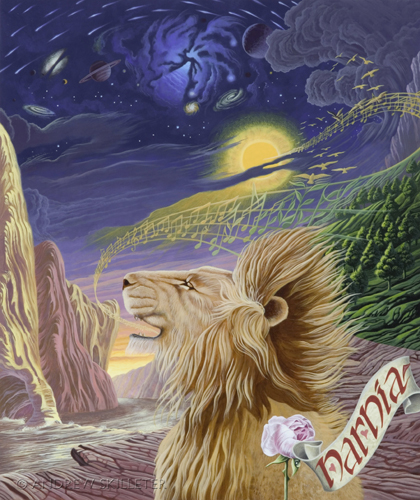
          A most beautiful sequence brings forth Narnia as a place. It starts, as in Genesis, as a void. Then Aslan’s voice sounds in the void and stars come, and sun, and water, and landforms, and plants, and animals, and then some animals are given the power of speech. I guess the cabbie and his wife become Adam and Eve, sort of. Narnia forms out of the song of the lion. It is quite ecstatic and I would love to see it animated. The rendering at the right does not do it justice.
          Digory becomes the old professor in LWW. He built the wardrobe from the wood of the apple tree that grew from the core of his mother’s apple. The wood of the wardrobe has Narnia in it. So, there are no loose ends in this series. Adding this book to my repertoire completes my knowledge and increases my appreciation of these beautiful books.

Wednesday, July 4, 2012

Chronicles of Narnia--One


          As I have been requested, this and the next few blog entries will present my impressions of C.S. Lewis’s Chronicles of Narnia. The books are taken one by one; a summary is presented after the last book in the series, but most of the reviews contain references to and observations of the series as a whole. The Chronicles are so timeless that it is hard to believe that they are less than 70 years old. The titles are:
          The Lion, the Witch, and the Wardrobe (1950)
          Prince Caspian (1951)
          The Voyage of the Dawn Treader (1952)
          The Horse and His Boy (1954)
                    The Silver Chair (1953)
                    The Magician’s Nephew (a prequel to the series) (1955)
                    The Last Battle (1956)
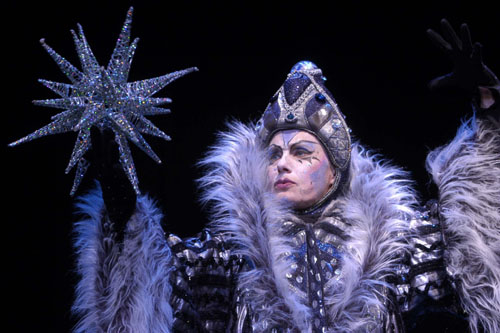
Narnia's evil White Witch
The White Witch from the musical Narnia: The Musical
Nazareth College Arts Center, 2009
          Unlike some other classic fantasy literature, these books have didactic purpose. Lewis had an agenda—to create imagery at the level of a child’s ability to process that would prepare their hearts and minds for traditional Christian instruction and traditional Christian character development.
          Lewis was far from believing that witches and fairies and ogres and other supernatural ephemera were Satanist, evil, or dangerous. Instead, he presents them as transitional characters to engage children in the processes of Christianity—forgiveness, compassion, sacrifice (to name a few)—in a manner of story-telling they can relate to. The great god-lion Aslan is the main guide for the many children who pass through Narnia and he helps them to understand sacrifice, death, resurrection, and the glories of heaven.
Aslan, from Kids Who Care Musical
theater, Fort Worth, Texas, 2006
          Thus, I don’t believe that these stories represent hero-journey or quest literature, in the classic sense. Tolkien also had a story-telling agenda, but his more metaphorical rendering of the act of Christian sacrifice made it entirely more universal as an experience. The characters in Lord of the Rings are much richer in their suffering and sacrifice—and they are for an older age group, an age group that supposedly is more able to deal with a sophisticated narrative. I wish Lewis had trusted his child audience a bit more.
          I love these books. I read them as a teenager and then again about a year ago as part of my Eager Readers book list quest. As a mature reader, I found them both more wonderful than ever and also a bit frustrating, as I was much more aware of the didactic aspect of the texts. I give an unqualified thumbs up to this set of books and hope you will read them to your children, read them for your adult self. Even adults need some magic now and then.

Travel with me now, to...

Lewis, C. S., The Lion, the Witch, and the Wardrobe
          The first Chronicle of Narnia, The Lion, the Witch, and the Wardrobe, last read 30 years ago. I found out after I read it that a different book is considered “first” in some approaches to Lewis—The Magician’s Nephew. I’m just going to read them all as I find them.
The four children and their uncle in front of the
wardrobe, Valley Youth Theater
          In LWW, four London children—Lucy, Edmund, Susan, and Peter—are sent to the country for safety as so many children were in Great Britain during World War II. The big old house they stay in is fun to explore and in one of the rooms, Lucy hides in a wardrobe. There is no back to the wardrobe—beyond the coats are fir trees and snowy ground. Thus begins the tale of winning back Narnia from the chilling White Witch. This can only happen when The Four (yes, those four refugee children) come to the land. The great god-king-lion Aslan can then return and free the land from years and years of winter (with never a Christmas!).
          The plot is a norm now, the standard-bearer for trips to mysterious places, but it is the characterizations that bring the book to life. Lucy is sensitive, and brave when it is in the service of others. Edmund is cranky, never satisfied, a trouble-maker. Susan doesn’t have much personality. Peter is a Head Boy sort of boy, brave and responsible. It’s nice that the children stay children, even in Narnia, and respond to events in that way.
Lucy and Faun
http://www.flickr.com/photos/daniellegreveraars
/with/1296951186/
          This series of books has been allegorized to death, so I’m not going to go that direction. I found this book enjoyable, highly readable, fast-paced, fanciful, intriguing, scary, funny, and plausible (within its own assumptions). I liked reading it and it made me eager to read the next one. In other words, it is a great success as a book. The imagery is beautiful and meaty—easy to project your stuff onto and to work stuff out. Something to chew on, in other words. The children learn lessons about themselves and each other.

Sidebar: Narnia The Musical
          A few years ago my nephew was in a musical version of Narnia, called (with great creativity) Narnia: The Musical. Even with the cast’s fine performances, the musical is a bit flat…but worth a review. The photos in this blog are from the musical.
          The first link here goes to a general site with music samplings. The second one goes to a series of 20 YouTube videos of all the songs in performance. Enjoy!


Monday, June 25, 2012

Instant Poems for Little Fairies

As dusk settled, so did the fairies, little girls in tights and wings, old ladies in togas and wild hats, men and boys dressed as pirates. It was Faerie Fest  in McArthur, Ohio. Children roamed the village park in costume or not, blowing bubbles, facing wicked trolls under the bridge, meeting the still fairies who would only move if you dropped a coin in their treasure chest, being painted with elaborate designs in paint or henna. The fest stretched across the park and I was most reminded of the July 4th celebration in The Music Man--a community out for a stroll and encountering wonders of art, music, food, dance, and poetry.

I did not see most of these wonders because I was the poetry fairy, Doleta (from Department of Labor Education and Training Administration, to whom I submit data in my day job). I was busy, writing 28 poems in about three hours, nine poems an hour. I never left my chair. In the paragraph above, I describe only the things I could see from my perch by the old stone drinking fountain (now only a seep)--much more was happening out of my awareness.


This is me in the hat...sorry the train doesn't show.
The girl being written for was much better dressed for
Faerie Fest.
I was adorned in a magnificent hat that looked most like a floral chandelier draped with Mardi Gras beads, wearing a dress with a train (a lace tablecloth pinned to my dress), and gold glittery sandals (ouch). On my gold and purple draped table (an old sheet and a discarded curtain) were my trusty clipboard and an assortment of pens.


I wrote poems on such a range of topics it made my head spin, from dogs and cats to chameleons; from peace to love to god; from pickles to drawing to...gosh, I can't even remember them all. I wrote a poem shaped like a spider. I wrote poems in which the first letters of each line spelled something. I would invite children to come over and get a poem of their very own--for free! Children are intrigued by poetry. Their curiosity overcomes the discomfort with poetry that has already taken root in their little souls. And no children can resist something that is specially just for them, one of a kind, on a topic of their choosing.


The child getting a poem sat in the special painted chair while I wrote, or sometimes ran along to another event and came back later, but when she heard the poem read for the first time ever, the magic happened. Eyes widened. People standing around grew quiet. The poetry time came over us all. And I folded the poem and handed it to the child. No copies made, no "I'll mail it to you." A special poem for each special child.


I didn't think this instant poetry thing up, although people think I did. I read about it in a book called Writing Down the Bones, by Natalie Goldberg, a book recommended by my high school English teacher Tom Romano, now a professor at Miami University in Oxford, Ohio. The book advised journaling profusely (it was the first time I'd seen the word journal verbed), which I had already done for years as an adolescent, and I have forgotten most of the writing suggestions, but Goldberg's idea of instant poetry stuck with me. The poem must be spontaneous, and you must give it away. No take-backs or keepers. The choice of topic must belong to the recipient. Goldberg saw it as an exercise in really getting the words out, taking risks, letting the writing flow.


I see it now as an exercise in letting flow, but also in letting go. It's a way to train myself to be in the now in an intense way and to prevent stockpiling and hoarding. Everything goes away...even our dear Earth will burn to a cinder and our beloved star will burn itself out. I must practice and practice this nowness of the universe. A gift freely given. Take this and fly, little fairy. Spread those glittering wings and get a glimpse into magic--the magic of language, of image, of rhyme, of nonsense, of humor, of love, of now, of time.


I wrote a poem for a boy on the topic of drawing, and I ended up goosing his active intelligence (very alive eyes) by writing about what makes something real. If you can draw it, is it real? Does that mean unreal things are real? By drawing, do you actually create reality? And what does that say about writing poems, right now, on the spot? I often felt like I was writing windows into other perspectives. What is the dog really thinking? What is truly great about pickles? How does something become real? I could see the click when a kid really got it, saw something from a different angle for the first time. I love that. That's my pay.


So, writing instant poetry makes me insanely happy, and exhausted at the same time. What better way to get tired than by working your words, by letting the child choose the words and then the words choose the child. Faerie Fest was a wonderful venue for instant poetry, because the children were already primed for magic, for wonder. I was concerned though, that the belief is abroad that poetry is for little girls. I love doing instant poems for adults, but they must be coaxed, even though I can see they want one. This concerns me and amazes me, that poetry has been minimalized and is only safe if it is for the very young. And I find it funny that my poems really are little IEDs, with little explosions for the child, if the poem works. Not safe at all.


A Sample Poem
Here is the instant poem I wrote for my friend Lynn Royer, on the topic of sisters. I wrote this in under five minutes and it fills one sheet of paper. I grabbed whatever images popped into my mind and then did a sort of rapid development. It's not edited, but it serves...it communicates...and if you have sisters, it makes sense. I copied it because I have sisters and I wanted to give it away again to them.


Sisters
If parents are the foundation of a life
Sisters are most certainly the framework,
Building walls, making room for rooms,
Holding up whatever becomes the roof of your life.
Sisters are windows through which to view yourself.
Sisters are doorways for going in and out.


Without sisters, life is just a shack
Leaning a little to the left
And sometimes with a small opening in the door
Shaped like a waning third-quarter moon.


Caution to those who want to try it
Wear comfortable shoes. I think my creativity was a bit off at Faerie Fest because those damn gold sandals were pinching and grabbing and itching. Please, poets, leave vanity behind and be as comfortable as you can when you try this. It's hard to go with the flow with your dogs barking.
Bad sandals

Friday, June 22, 2012

Explosive 18 by Janet Evanovich

Note: The film stills in this blog are from the movie "One for the Money," the first Stephanie Plum book.


Evanovich's phenomenological approach to the symbology of post-feminist existentialism undermines the classical structure of the modern comedic text. Responses to her lexicon are decidedly combinational; analyzing only for classical structure of the comedic text alienates the reader-responder from a deterministic experience of the ambifocal narrator. Does the book succeed? Only a determinist could process the imagery of comedy. Only a post-feminist analyst could process the extential classical structure. Only a post-hedonist could properly interpretize the sexual ephemera.

There! Just wanted to see if I could still write a paragraph like that! Let's start over.

Explosive 18, by Janet Evanovich, is, you guessed it, the eighteenth novel in Evanovich's Stephanie Plum series. It is highly readable and, as always, surprising. But Explosive 18 has more of a Laurel and Hardy feel to it than the previous book (you guessed it, Smokin' 17) by this author that I reviewed. Smokin' 17 had a unity to it, a set of repeating images, and no extraneous stuff. Explosive 18 is full of extraneous stuff. I questioned why the sidekick Lula was even present, aside from comic raunch-relief. She didn't make the plot happen. There was an icky sequence of Lula falling in love with an idiot that I never did really relate to the rest of the plot. It was funny, sort of. And I'm tired of Stephanie Plum's ongoing and ongoing and ongoing relationship crisis. Get off the fence, sister!

Don't get me wrong. I loved this book and enjoyed reading it, but it didn't have much impact. I guess it is really one of those "summer books." The funniest bit involved a shoulder mounted rocket launcher--and I wish the author would have integrated it into the entire plot. It was hilarious to picture the short/large Lula with the launcher resting on her bosoms.

Plum's plums: Joe Morelli (Jason O'Mara), left;
and Ranger (Daniel Sunjata), right.
First paragraph aside, I do think Stephanie Plum is the poster girl for post-feminism. She has a traditionally male job (bail-jumper hunter) but isn't all that great at it. She carries a revolver and a stun gun but frequently forgets to load/recharge them. She sleeps with whomever she chooses but tortures herself about it. And, her man Ranger runs in like a deux ex machina to rescue her whenever events get too hot to handle. She's tough and practical, pragmatic even. There is not much room for beauty in her life or these books.

This book (and all the Plum novels) have three saving graces. The first saving grace is Stephanie's family, which serves as a consistent background to this entire series. Her sluggard dad, tippling mom, and go-go grandma are just plain funny. In this book, they provided most of the laughter. The family is sort of a Greek chorus to Stephanie's life...they stand in for us, the readers, the wacky readers.

The second saving grace is the amazingly funny action scenes and the wry humor that infuses them. Stephanie is such a klutz that luck is a better ally than a gun. She has several run-ins with a thug named Razzle Dazzle and always comes out ahead, somehow, and I ended up laughing at every single injury inflicted upon him.
 
Stephanie, center, with Lula, left, and
a former colleague of Lula's.

The third saving grace is the wonderful character description of the people Stephanie comes across in her work and in her world. This a book set in a very specific place in New Jersey and the details are rich and alive. Right down to the gossip at the bakery counter, the crazy man who camps out in the cemetery, Lulu and the whole gang at the bail bond agency. It's wonderful to have them in my world, too.

Notice how I haven't hardly mentioned the plot? In this book, the plot was sort of an excuse for the interaction of a set of characters in a place and at a time. Plot just wasn't that important. Smokin' 17 was a roller coaster that brought you back around to the beginning. Explosive 18 is a roller coaster that just keeps on rolling--you can jump off, but who would want to?

Please note: If you want to protect the purity of children's minds, keep them away from this author until they're ready for some non-love-related sexual content. Yep, the unmarried Stephanie likes sex and tries to have it whenever she can fit it in. And she has two different but equal male partners. And her sidekick Lula is a former hooker (reformed).

SIDEBAR: Stun guns

Stephanie Plum's weapon of choice is the stun gun, and in the hands of author Evanovich, this weapon is hilarious. And it's as funny when it doesn't work as when it does. Its pervasiveness in this series of books makes me think that private use of stun guns is much more frequent than I could imagine. I like it.

Stephanie uses her stun gun offensively--she goes after someone and stuns them. I wonder how a stun gun would be as a defensive weapon. I can't imagine letting a criminal get close enough to me to stun him or her, but I like the idea of not having to aim (aiming is not one of my--or Stephanie's--best skills). I would truly prefer something like a Star Trek phaser, more of a point-and-stun weapon. I don't seek to kill or injure. I just want breathing space to call 911. Actually, I probably just need a remote 911-dialer, maybe a button that hangs on a chain around my neck. Like Life Alert for the elderly.

I have just talked myself into a weapon that is assoicated with the feeble. This is how it happens, folks...go get a stun gun. Really.

Thursday, June 14, 2012

Abraham Lincoln: Vampire Hunter, by Seth Grahame-Smith

     Abraham Lincoln: Vampire Hunter. More bizarro literature from Seth Grahame-Smith. Wait, let's change the word literature to writing. I'm not sure how this book, or Grahame-Smith's Pride & Prejudice & Zombies, will hold up over time as literature or that they are literature at all. They are amusing novelties, for sure, but awkward and a bit profane, if the truth be known. What sacred cow will Grahame-Smith take on next, Sue Barton: Plague Spreader Nurse?
     Still, I have to admit that AL:VH was a fun read, blurring the lines between history and fantasy, and really goring it out with beheadings, axings, gunshots point blank in the face. I couldn't wait to see how the plot device would play itself out--turns out that the Civil War was started by vampires who wanted to enslave not just Africans but everyone in America to insure a steady supply of fresh blood. The scenes of vampires preying on enslaved blacks were among the most gruesome and profane.
     Young Abe, growing up on the frontier, comes across vampires early and often. He sharpens his wits along with his trusty ax blade while his career is shaped by divine and vampiric intervention in a giganto conspiracy of "good" vampires (northern) vs. "bad" vampires (southern).
     Imagine the staid and conservative Biographies of Great Americans you used to read in your elementary school library. Now imagine one of those books ripped apart and infused with vampires. That's this book. It's like the classic girl's biography of Abigail Adams turning out to be about a guerrilla abortionist midwife rescuing women from unwanted pregnancy or something. (Now we find out why she kept trying to get John to send her more "pins.")
Abe Lincoln's weapon of choice
     I found AL:VH funny and compelling for all the wrong reasons. The distortion of reality disturbs me, because I know Colbert's concept of "truthiness" by which the thing which seems most important or truthful becomes the accepted actual truth. I was laughing at the absurdity of the concept while worrying about this book being the only exposure to Abraham Lincoln's life and work that some people might ever get. And don't get me wrong, Lincoln is portrayed heroically; he is not lampooned. Alas. There is nothing I can do about it. I think this is a plague of middle age--to worry about people not getting the past right, wanting to carry the past along into the present and the future.
Front and back cover of the book--inspired!
     What I really like, though, is that Grahame-Smith has taken his concepts and run with them. He has asked the great "what-ifs" and insisted on answers. What if Hitler was a direct and secret descendant of Thomas Jefferson from his liaison with a Jewish-African slave? What if...what if. It's an outrageous game.
     I'm alarmed that the last several books I have read (the eight Redwall books and the two by Grahame-Smith) all involved incredible violence against dehumanized enemies. Once you call someone a vampire (or a zombie, or a fox, or a rat) you can do anything to them. And that dehumanizes you/me. We want the thrills of senseless gore and violent action, but we don't want the emotional baggage. I don't believe that this reading material necessarily would lead to acting out, but I just think it bears noting.
     But, hey, it's a puff piece. Read it at the beach and wonder about every single person who comes by wearing sunglasses. Have fun with it. I did.

Saturday, June 9, 2012

Pride & Prejudice & Zombies, by Jane Austen and Seth Grahame-Smith

Greer Garson and Laurence Olivier as
Elizabeth and Darcy. Now picture a zombie
face at the window!
     I loved Pride & Prejudice & Zombies and couldn't stand it. It failed in what it tried to do and succeeded in what it didn't try.
     As a piece of comic writing, this book failed. Grahame-Smith wasted an opportunity to really infuse Austen with zombies--the undead appeared infrequently, missing many opportunities to develop this book as a stand-alone work of comic horror. Really, zombies should have appeared randomly every few pages, but instead long passages of extracted Austen totally lacked brain-eating and bludgeonery. The zombies were more a novelty than anything else and did not contribute to the plot, which steadfastly followed Austen almost to the death (but not by zombies). It was a completely missed opportunity. I hope the impending film version of P&P&Z rectifies the failed courage of the book.
Warrior Elizabeth
     So, I was disappointed. I wanted a campy post-apocalyptic romp and got Austen more embroidered than anything else--and not embroidered with flowers, but with ghastly needlepoint body parts and gore. Lovely! Still, it was great fun and not at all serious--a great read for a summer weekend.
     I was heartened by the strength of Austen's story, even truncated as it was. I have read the original Pride & Prejudice maybe a dozen times and I know that story backward and forward. I have seen at least 10 filmed versions of the novel. And still, yes still, the story hooked me and held me. It didn't matter whether Elizabeth slayed with a glance or with a Katana sword or whether the carriage was  spattered with mud or with guts. The main point was whether Elizabeth and Darcy would find it within themselves to love each other, whether they could combat pride and prejudice in each other and themselves as efficiently as they slaughtered and beheaded the undead.
Zombies are everywhere, man
     In this book, Elizabeth and her sisters are trained zombie killers, warriors, really. The plague of zombies has overtaken England as the dead rise from centuries of cemeteries to menace both town and country. (London has been sectioned off into walled quadrants to better fight the unmentionables). These plot aspects are draped around Austen's plot in utterly silly ways. And hey, silly is OK. I liked it. If it brings readers even one step closer to appreciating Austen or voluntarily (Jake Shapiro) reading her books, I'm even more tickled.


SIDEBAR: Me and Austen
Books: My Life
     I knew I was supposed to like Austen, like I was supposed to like Dickens and James Joyce and Fielding, and so on. To be a proper English major, I must like them, to outstrip my high school friends in literariness, I must read them. But I just couldn't get Austen. It was so damned wordy! So polite! These books were politely written even when describing hideous social faux pas, wrongs, and sillinesses. I cleaned house for a professor while I was in college and one day she gave me a set of seven Austen novels and I took them gladly, if only for their symbolism.
     In the summer of 1980 (oh, those were halcyon days--NOT!) I went to England. And when I got home, I got Austen. I loved it. I dusted off the seven Austen novels and devoured them as eagerly as any zombie goes for brains; I redeemed those books from mere symbolism and they took on an amazing life in my life. And those books were no cauliflower (which zombies mistake for brains)! They were the real thing. Suddenly, the gorgeousness of Austen's writing shone through; her grammar, her perfect word choices.
Holden Caulfield (not cauliflower),
one artist's vision
    I think now that certain brain development (brains again!) and education needs to happen before a reader can appreciate certain literature. I see all the time that students are assigned literature to read that they cannot under any circumstances understand or appreciate. And you can see the fire light when a reader gets the right thing at the right time--like me reading Catcher in the Rye in 11th grade. As I consumed the book it also consumed me. I was irrevocably altered.
     One of the delights of the Eager Readers list I am working on reading is that I have revisited books that I read before I was ready. Dickens. I would've missed him but for this reading project. He's the best gift I've gotten. Rereading all of Austen was also an amazing pleasure. Neither of these authors ever intended for their audiences to be schoolchildren. These are adult works with amazing brilliance and scope. Coming to them as a mature reader and writer I again consume and I am again consumed. Wonderful! Very zombie of me.