Search This Blog

Showing posts with label J.K. Rowling. Show all posts

Monday, July 23, 2012

Rocketship Galileo by Robert A. Heinlein

The 1947 cover--telegraphs the fact that
the science might be a bit out of date
          I'm going to discuss a lot of negative features of this book, so I want to be clear at the outset: Rocketship Galileo, by Robert A. Heinlein, was a great read. It was a fast, funny, exciting adventure story that had my hair standing on end more than a few times.
          Rocketship Galileo is the story of three teenagers who make up the Galileo science club. Through a combination of happenstance and connections, the trio gets hooked up with a pioneering ex-professor who has a plan for a rocketship that will go to the moon. (Funny that rocketship is not accepted by spell-check--fifty years ago it would have been, except for the non-existence of spell-check at that time--two ships that never did pass in the night.)
          The tone of the book is very much "Hardy Boys Go to the Moon" but with a didactic science backdrop. The teachable moments, when the professor would teach and/or quiz the boys on technology, mathematics, astronomy, computer science (!), physics, electronics, welding, and materials science, were a bit dry. The basic science was solid, but the implications for technology, computers, and space travel were hilariously out of date. At least within the context of the book, however, there is scientific consistency. The biggest boner was that no mention was made of the tendency of objects to burn to a cinder when they pass into or out of Earth's atmosphere. The team's ship had no heat shields and took off as a nuclear jet plane and just flew off into space from the New Mexico desert.
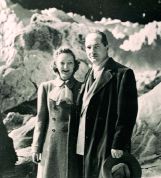
Robert and Virginia Heinlein on the set of
Destination Moon in 1949; the film was based
 on his novel Rocketship Galileo.
 
          These inconsistencies did not bother me. I knew when I saw the cover of this book that it was from the immediate post-World War II era (1947), a time when nuclear science and its implications for the future were in their infancy. It was more the slow start than the quaint science that bogged me down. 
          Rocketship started slow--the early scene-setting was tedious and did not have enough tiny hints to indicate that something exciting was about to happen. The boys end up traveling with the professor to a camp at, yes, ground zero at Alamagordo, where the first large-scale nuclear test occurred in 1945. Our team of unlikelies were in New Mexico to build a nuclear rocketship. Nuclear power is like a cloud of question marks to the book's characters. The characters express horror and sadness over the way nuclear power was introduced to the world--Hiroshima and Nagasaki. They are determined to find productive uses for this schizo-wunderkind of science. The aftereffects of radiation, genetic damage, long-term poisoning of  test sites, these are not yet or bad-dreamed of--although nuclear terrorism is seriously discussed among the professor and the boys.
Alamagordo, New Mexico: Now am I become death.
          All caveats aside, after the first two chapters, I was completely hooked and didn't let go of this book. The story-telling process was wonderful; the pace was perfect. And, if you've read my blog much you'll know how important this is to me: the ending was great; I don't mean the outcome of the plot, but the design of the last chapter itself. When the adventure was over, the book was over. That's the way to do it. No need for some corny wrap-up chapter. Throughout the book, the characters imagine what will happen to them if they meet their goal, if they make it to the moon and, more importantly, make it back to Earth. If readers need to imagine more, they have plenty of material to work with. If only J.K. Rowlings and Suzanne Collins had done this. Just stop. Stop when the book is over. A book is not a sitcom that has to have a 3-minute follow-up after the last round of commercials to let us know that everything is OK or a drama that has to hook us for the next episode. When the action concludes, please just stop. And, I may need to send this message to editors also, because I think it might be the editors or publishers who want that extra chapter of pap. Enough ranting...
A comic book knocking the stuffing
out of a Nazi--and this is from 1980!
          One of the funniest things in this book (funny to someone in her fifties), is the sudden appearance of excaped Nazis in a very surprising place. I laughed out loud, because I had forgotten the number of comic books, TV show episodes (I think of "Hogan's Heroes" and many episodes of "Mission Impossible"), and movies featuring escaped Nazis I had encountered in my media consumption as a child. The Nazis were convenient villains for almost any situation and at any time. They would never give up on bringing Hitler's vision to fruition. I thought, "oh, we used to HATE them," and giggled.
          Now we've gotten so apologist about everything. I've forgotten how fun it was to have an evil enemy to fool, outsmart, trip, spit on, shoot, toss into precipices, and be righteously superior to. Please note that I have grown out of this black/white vision of the world, but it sure made things easier. And, it puts this book in the context of many of the books on my list that develop a dehumanized enemy to allow the "good" characters to justify their "courage." I'm thinking particularly of the Redwall books now. Even Narnia somewhat dehumanizes the enemies to make them hurtable.


Culture of science wet dream of the 1950s
          The only female presence in this book is three marginalized moms, mothers of the three teenagers. After Chapter 2 or so, no females annoy the proceedings. And, although the movie version apparently had a darker-skinned person (probably playing the Italian boy), there is no color but white in this book. The team is cooperative and constructive and their genius is peculiarly suited to the task at hand--building a nuclear rocketship by hand. But, the characterization is fresh--no one is perfect and they all pitch in to cover the consequences of fallibility of each other--and almost idyllic. So, idyllic is white, male, and scientific. Well, that's nothing new! Again, I took this book in its 1947 context, but that doesn't mean I didn't note the details.
          Was Rocketship Galileo a hero journey? The boys evidenced some degree of maturation, but this book was not much of a hero journey--more of a thrill ride. The boys were pretty much fully formed from the start. Still, there is a 1950-esque version of the hero journey--the mastering of technology to find wealth and fame. But the tone of this book (if not the action) doesn't support this myth well either. I'll stick with the "thrill-ride with scientific pretentions" idea. 
          The actual moon landing 22 years after this book was written pales in comparison--it was so over-planned and over-imagined that nothing bad could hardly happen on the moon (although it could in the capsule itself and on take-off and landing). Compared to Rocketship Galileo, the real moon landing lacked drama. Sorry NASA. No brag, just fact.
          One last observation: My enthusiasm about this book points out to me that I am not just a nerd; I am also a geek.


Sidebar: Destination Moon

Here is a link to the trailer for the movie "Destination Moon," released in 1950 as an adaptation of Rocketship Galileo: http://www.imdb.com/video/screenplay/vi3181445401/

The professor and "the boys" in the 1950 film adaptation
of thebook, released as "Destination Moon" 
          The book is darned progressive and liberal compared to the movie, which added more representatives of the military-industrial complex, which were pretty much absent from the book. In the book, the professor was the only authority figure and he was pretty fallible. And, from the IMDb website, I could not determine if Nazis are a part of it. The costumes were terrible, but the sets were pretty good. Makes "Lost in Space" seem a marvel of special effects. However, author Robert Heinlein was actively involved in the production and the script. I wonder if he was really happy with the results.


Here is some dialogue from the IMDb site that takes place nowhere in the book and is way more rah-rah industry than the book is. Propagandists had clearly gotten involved.


[Why the government isn't involved if it's so important
Jim Barnes: Here's the reason. The vast amount of brains, talents, special skills, and research facilities necessary for this project are not in the government, nor can they be mobilized by the government in peacetime without fatal delay. Only American industry can do this job. And American industry must get to work, now, just as we did in the last war! 
Industrialist: Yes, but the government footed the bill! 
Jim Barnes: And they'll foot this bill, too, if we're successful; you know that. If we fail, we'll take a colossal beating. So we can't fail! Not only is this the greatest adventure awaiting mankind, but it's the greatest challenge ever hurled at American industry. And General Thayer is going to tell you why. 
General Thayer: The reason is quite simple. We are not the only ones who know that the Moon can be reached. We're not the only ones who are planning to go there. The race is on - and we'd better win it, because there is absolutely no way to stop an attack from outer space. The first country that can use the Moon for the launching of missiles... will control the Earth. That, gentlemen, is the most important military fact of this century. 

Thursday, March 8, 2012

Mockingjay & the Trilogy, by Suzanne Collins

If you have not read Mockingjay, please cut the two-page epilogue from the book and burn it before reading. This Happy Ending Device trivializes all three of the books that have gone before and insults the intelligence of the reader. I can't believe Collins fell victim to the same Happy Ending pressures that felled J.K. Rowling's Harry Potter series. And they all lived happily ever after...after unspeakable trauma, the epilogues of both series are crushingly bad. I have removed these pages from my copy of Mockingjay.

YouTube has many videos of Suzanne Collins, including this one of her reading the first chapter of Mockingjay:  http://youtu.be/1MY6yEt6aZs

I finished Mockingjay a few days ago and I feel confused--as confused as our hero Katniss feels most of the time. The amount of death and violence in this book makes Hunger Games and Catching Fire seem mild. Yet, I kept reading and felt compelled to do so. I am disturbed that I liked such violent books so much. And I am disturbed with the duality of Katniss's role. She flips like a coin in the air from ingenue beauty queen sweetheart to hard-bodied killing machine soldier.

Where is Katniss herself in this pink/black dichotomy? That's the question that kept me going. How would Katniss survive this role whiplash? I have felt this so many times (especially in adolescence)--that the choices presenting themselves don't fit me at all and yet I am forced to choose one. As I discussed in my blog on Catching Fire, it is the fact that these books are psychology evocative that makes them so good. I have many times felt the hate and blackness and helplessness and coercion. The images that I have searched for to represent these feelings have been violent and black. (I wrote a poem titled "Birth of the Baby of Death"!)

A scruffy tiger cat helps humanize this book.
I could write a complete essay on the cat's
role in the story.
Mockingjay finishes out Collins's trilogy. Katniss is still on her feet, physically safe, but filled with guilt, horror, and anger. She is turned into a public relations device for the districts' uprising against the Capitol, a pawn who once again is manipulated into unthinkable relationships with unspeakable horror. And the reader shares the impact of all of this with Katniss. She struggles to maintain her humanity in the face of her own participation in every level of coercion and violence. I won't go into detail about the plot...it's a war story.

I loved Katniss. I wanted to help her. I wanted to see her survive somehow, some way, somewhere. My engagement with her was one of the key factors in keeping me reading through to the end. Her fate became entwined with mine--if she could find a way to keep going, I guess I can. When I imagine what I would have thought of these books if I had read them 35 years ago, I see my teenage self clinging to these books, keeping them by my bed, valuing their reflection of my inner turmoil.

And truly, if you want to step way, way back and get all metaphysical, these books can be viewed as a hero journey for the adolescent. Adolescence can be seen as a lengthy battle for identity, autonomy, value, perspective, and wisdom. Adolescence is a fight like Katniss fights.

And, of course, these battles never really end as I grow into middle age, but I have more tools and strategies now, and nothing inside me is as serious as it was then. The important things are outside me now. And Katniss finds out what we all sort of find out (or should)--that sometimes evil is not punished, sometimes wrongs are unrighted, and many questions go unanswered. Loving anyway is what comes out of the struggle. Loving yourself anyway, loving another person, loving life anyway. Emerge from the flames and ashes still able to love.

The Hunger Games trilogy is impressive and strong. Even with all the violence and torment, I wouldn't hesitate to recommend these books. They have some strong truth in them.

Much useful information at this site, including summaries, character lists, study guides, and other resources on this trilogy:  http://www.gradesaver.com/author/suzanne-collins/