Search This Blog

Sunday, March 9, 2014

Appalachia Project: The Dollmaker, 1954

The Dollmaker, by Harriette Arnow

It's a sprawling book--an epic, though it covers barely a year (1944-45) and only a few hundred miles. The heroine, Gertie Nevels, travels farther in that year than an astronaut going to the moon and makes adjustments that took nations a century. Gertie starts out in an agrarian life little changed from that of her Revolutionary War ancestors--she follows the seasons and the needs of the crops and livestock. She spends most of her time outdoors and has little contact with any people outside her own family. Gertie is a success in agrarian terms. She can birth a calf, plow straight, plant at the right times, mend harness, sew, churn butter, and whittle. She is congruent with her world.

The Dollmaker takes place against a backdrop of World War II. The war takes all the men away from her community. This disruption in the life of subsistence farming is dramatic and leads to the eventual depopulation of Appalachia. Waiting for news becomes the focus of the women left behind. Gertie's husband must choose between evils--the army or the factory. He chooses the factory, which is better for his family. The irony of this decision drips through the book, as his family suffers.

More people came down the lane: children running, women with babies in their arms walking tiredly, old women like Sue Annie, hurrying, with no wind left for gossiping. They would see her and forget the old greetings of other days like, "How's your mother a holden up, Gertie?" or, "Law, law, it's been a time an a time since I've seen you. When are you a comen to stay all day?" Instead, they all, young and old, asked with breathless abruptness, "Has the mail got in?" (pages 151-152)

In the course of a day, Gertie's world rocks on it foundations. She follows her husband to Detroit, Michigan, where he has taken a job in a steel mill in lieu of going into the army. She moves into ticky-tacky cheek-by-jowl worker housing in a filthy neighborhood next to the factories and an extensive network of railroad tracks. Noise, light, smoke, traffic, yelling, neighbors arguing on the other side of paper thin walls--these assault Gertie, a cacophony of ugliness.

She had never lived with a clock since leaving her mother's house, and even there the cuckoo clock had seemed more ornament than a god measuring time; for in her mother's house, as in her own, time had been shaped by the needs of the land and the animals swinging through the seasons. She would sit, the knife half forgotten in her hands, and listen to the seconds ticking by, and the clock would become the voice of the thing that had jerked Henley from the land, put Clovis in Detroit, and now pushed her through days where her work, her meals, and her sleep were bossed by the ticking voice. (page 210)

The steamy, nasty smell of the drying, half rotten reused wool mingled with the gas smell, the chlorine water smell, the supper-getting smell, and became one smell, a stink telling her it was the time of day she had learned to hate most. The time she had loved back home, the ending when the day was below her. (page 265)

It took Great Britain and North America more than 100 years to accomplish what Gertie did in a few weeks--obliterate the agrarian and adjust to the mechanical. Gertie's experience reminds me of tales of isolated villages in the Amazon basin who come into contact with modernity for the first time. We like to see them as amazed, but, like Gertie, they might just be horrified.
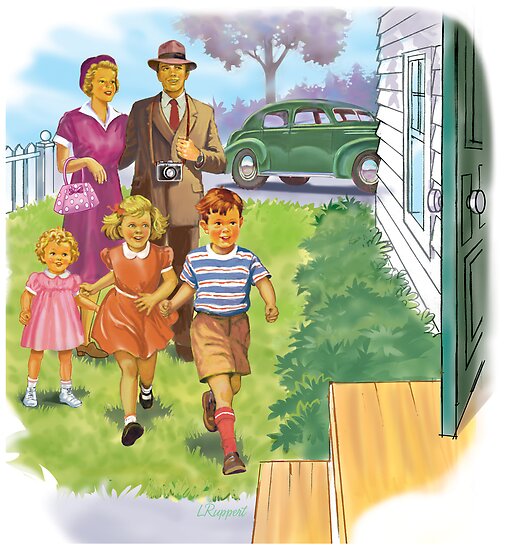
The Dollmaker can be viewed from so many different angles that I actually have a list--and it is about 25 items long. One of the key perspectives is the immigrant experience. The work force in Detroit comes from around the world and many of the people have no point of reference for city life. People from the Appalachian region were doubly alienated--as clueless as any immigrant but without the expectation of strangeness. Gertie had no reference point for the environment she moved to and was disoriented by how badly the new environment completely unmet her expectations. Many of her expectations were form from primary grade readers her children got from school back home--happy, helpful policemen; pretty streets with rows of trees; nice manicured yards around every house; sidewalks.

The real butter, that was to have been a Christmas treat with hot biscuit, had got so hard and cold from its stay in the Icy Heart (fridge) that it refused to melt even on the hottest of the biscuit, and butter and biscuit were chilled together. Clytie (oldest daughter) had put the lettuce in the wrong place, and it was frozen. Reuben (son) complained the milk was so cold it hurt his teeth. Clytie blamed it on Enoch (another son), who'd turned down the cold controls; Enoch was angry; and Clovis (husband) turned sorrowful because the Icy Heart, like Cassie's new doll and the other things he'd bought, was unappreciated. (page 288)

I have also heard that at times in the past quarantine of Appalachian peoples onto reservations was considered. Surely, the population of the region is dwindling due to substance abuse, poor medical care, and economic hardship--some of the same conditions prevalent on Indian reservations. I'm fascinated by this kind of observation. I see myself as part of a fragile population and fragile culture, both of which are at risk of winking out.

I certainly remember feeling like a foreigner as a freshman at Ohio State in 1977. I had never knowingly met a Jew or a Catholic. The pace was whoosh-whoosh-whoosh. And I was pretty intrepid...just kept pushing until I understood...lots of observation before action...but I still never felt a part of the place. Always felt a bit like a visitor, a student from another country who could be educated but not particularly enculturated.

...She had wasted Clovis's money for rotten bananas and poor meat and all the other things they didn't know about--the box of pepper half full, the rotten eggs, the rotten oranges, the sweet potatoes bought as a treat one night but all black in their hearts, yet showing no sign from the outside...She gripped the door handle. She could raise bushels of sweet potatoes, fatten a pig, kill it, and make good sausage meat, but she didn't know how to buy. She could born a fine and laughing boy baby and make him grow up big and strong, but inside him all his laughter died. (page 350)

The Dollmaker is a slowish read. I was distracted at first by Arnow's dialect spelling. She used "u" for the article "a" and in the word "to." The "u" stood for the sound "uh." She also used "th" for "the." Once I got used to it, I found that it represented the sound of the speech quite well--and certainly with less difficulty than Twain's excessive use of apostrophes. For non-Appalachian readers, Gertie's word use might be difficult. "If we'd ha stayed, I could ha hoped Grandpa with them yoes." If we'd have stayed, I could have helped Grandpa with the ewes."

I've heard Appalachian speech most of my life and can pop out with a good one every now and then to this day. I just have to channel my grandparents and aunts and uncles. My mom got trained in "proper" speech and struggled to sound "right." From her I got a grounding in standard speech. Speaking proper has always been a help (holp) to me. If I had sounded Appalachian when I went to Ohio State my experience might have been very different.

In addition to speaking a different dialect, Gertie also suffered from being taciturn--she was not talkative. She struggled to find words for objects and phenomena she had not conceived of before moving to Detroit. She struggled just like any other non-English-speaking person. I remember feeling that way when I went to Germany. Even the German words I knew were hard to produce. I just couldn't get them out.

Mrs. Anderson opened the door, but Gertie turned quickly about and started down the steps. If she could walk now, walk all night, walk and walk, forever; if she had corn to gather, like for Henley, even a cow to milk, some gentle cow that would let her lean her forehead...Clytie and Enoch, who had been listening to the radio, sprang up. Clytie started toward her but stopped in the doorway and stared at her, then slowly backed away, her mouth open, her eyes wide, unable to leave the twisted, soot and blood-streaked face that seemed not a face at all, more like a mask such as children wear at Hallowe'en to frighten other children: and out of it blazed the eyes that from being gray and forever calm were black now, glittering, fighting all things, even [her] children. (pages 413-414)

Gertie spoke most eloquently with her hands and a knife. She carved wood, or whittled, as she called it. Whittling, though, as a connotation of frittering, killing time; whereas Gertie was a gifted artist in wood. She had a log of straight-grained cherry, maybe 18 inches tall and 18 inches across. Somehow, in spite of working 18-hour days, she found time to work on this log--to make an image of Jesus. Or was it Judas? She wasn't sure whose face would emerge from the wood. At the start of the book, only the top of the head has been carved. By the end of the book, the statue is complete except for the face. The insights Gertie gains from working on this piece of wood are the crux of the story. Images of Jesus include a vision of a laughing Jesus that came to Gertie right before her rural life ended; a shrunken and suffering Jesus on the cross on the crucifixes she saw in her Detroit neighbors' homes (she had never seen a crucifix); and various other bland and sober depictions.

Gertie's theology was mostly of her own making. She was notorious in her Kentucky county because she did not go to church, rejecting the hellfire and damnation theology preached there. She saw so much beauty and wonder and grimness and death in her wandering through her world; she formed her own beliefs of a loving, laughing Jesus from her own experiences. Gertie's main question about Judas was whether he was or should be forgiven by Jesus. He had no idea that his action would bring about such dire consequences. And he tried to give the 30 pieces of silver back. Gertie knew that she was a sinner also. Would she be forgiven?

She missed him, but could never tell him how she missed him most. She hated herself when she lied, trying to make herself believe she missed him the way a mother ought to miss a child. In the old song ballads mothers cried, looking at tables with empty plates and rooms with empty beds. But how could a body weep over a table where, even with one gone, there was yet hardly room for those remaining. The gas pipes were still overcrowded with drying clothes; and eight quarts of milk instead of ten in the Icy Heart meant only less crowding, not vacant space. Two pounds of hamburger cost less than two and a half and-- She would hate herself for thinking of the money saved, and try never to think that living was easier with no child sleeping in the little living room. (page 369)

Gertie's statue of Jesus shows that he is holding something. Is he taking it? Is he giving it back? Is it running through his fingers? What is it? The answer Gertie recieves forms the final apotheosis of the book. It was an answer I didn't understand when I read this book 30 years ago. My new understanding did not lessen the impact of the act. It was consistent with Gertie's inner understanding.

The Dollmaker can be seen from the "noble savage" perspective--the idea that "primitive" people have something that we evolved people have lost. I've seen many versions of this-that being closer to nature give you special insights when it often only gives you rickets, lice, lung cancer, and ignorance. Gertie is smart and insightful because she was smart and insightful to begin with. She has those gifts whether she is in the Eden of Kentucky or the Hell of Detroit. In each place, there was a range of abilities in the population. And, truly, Gertie's isolated world hurt her in her attempts to understand urban life. She agonized over so many mistakes, knew that her big boots and unstyled hair and unpainted face scared the people she met.

...it seemed so long ago that she had felt as that woman felt now--going to a place that would be paradise. Paradise: it was a pretty word. She'd never thought how pretty it was until now. When the woman spoke it in her soft rich voice, it made her think of peaches, pure gold on one side, red in the gold on the other, soft, juicy, warm in the August sun, warm-tasting like the smell of the muscadines above the river in October. "It's a pretty name," and remembering, twisting the hurt inside her, she said to the woman what she had said to herself, "'This day thou shalt be with me in paradise.'" The woman laughed. "That's what mah man said to me, only in different words." Gertie nodded, and her voice was defiant. "I'll allus think that a body oughtn't tu have tu die first to git it--that is, at least for a little--a paradise on earth."

Leaving Eden. Going among the world. Making a supreme sacrifice. Gertie's story parallels that of Jesus. Arnow uses the imaginary friend of Gertie's youngest daughter, Cassie, to deepen this theme. Cassie and her "friend" Callie Lou are best friends and go everywhere together and process Cassie's experiences together. To Gertie, this is for the most part harmless. But in Detroit, it is seen as crazy and odd. Gertie knows she should help Cassie adjust (a loaded word in this book) by, as she sees it, killing off Callie Lou. She must force Cassie to give up her own version of the laughing Jesus. The consequences of this action are heart breaking.

I've heard this book labeled as feminist, but I don't see it that way. Certainly, it could be used to support many discussions about the role of women and the issue of powerlessness. Gertie felt that her husband had the right to control the direction of the family and that's how it went. That's how she ended up in Detroit. But she didn't struggle against it. You can also see this book as reflecting women's tendency to build community. The women in the factory housing formed a supportive group--they took care of each other's children and tended to sicknesses and grief. This is another of the themes for Appalachian literature that I am tracking. Real life is centered in the women. Only in this way does Gertie's Detroit neighborhood resemble "back home."

And, there is beauty in the filthy and crowded Detroit slum. It is in the faces of the children and the kindness of the people to each other. Even those who wish to remain apart end up as participants in the life of the alley. As Gertie's painter neighbor observes:

"Always I hated it, this alley, the ugliness, the noise--there wasn't time or quiet in which to paint--and of course nothing to paint. I never saw them--the pictures; Wheateye [little girl] standing on the coalshed roof with a popsicle in her hand...strange, I never saw her then, but I do now; dirty with popsicle juice dribbling down her chin; there'd be flies buzzing round, and the gray houses and the dirty trash cans, always spilling, and the back steelmill smoke, but there she would stand on the coalhouse looking up at the clean, silvery airplanes...But I never saw her." (pages 440-441)

The Dollmaker is a book of great poverty that leaves me with great riches and a window through which to view my own heritage. My family, too, left the Eden of Appalachia, although it was more of an escape to them than an expulsion. We were a bit on the outside, which was a gift and a curse. I know my sense of not belonging has contributed much to my abilities as a writer. Knowing Gertie helps me love relatives long dead now who I did not understand as a child. Strange Aunt Hazel. Odd Cousin Robert. My dad's brother Jim. My grandpa Homer Burton. Even my beloved Aunt Mabel and Uncle Melvin (still living, thank goodness!), who managed to stay on the land at some cost.

You know me and endings. Well, the ending of The Dollmaker was great. I don't mean happy. I mean that Arnow saw the ending, wrote it, and stopped. She left it in our hands as it was. Now I have to carry that act of Gertie's as part of me. I am changed by it. That's a magnificent ending.

Sunday, February 16, 2014

Poem of love written for Winter Soiree

Photo: Reposting my amazing hearts photo from a car pulling into and then backing out of a parking spot. Happy Valentine's Day.

Come What May

by Joy E. Dickreson, February, 2014


When you are scared, I will hold your hand
And stand beside you come what may
I’ll blaze the trail
I’m by your side
I’m right behind

When you are glad, I will dance with you
And prance with you come what may
I’ll whirl and spin
I’m in your arms
I lead, then you

When you are sad, I will cry with you
And offer my shoulder come what may
I’ll hold the pain
I’m holding you
I dry your tears

When you face injustice, I will fight with you
And right the wrong with you come what may
I’ll speak the truth
I’m angry too
I slay the beast with you

When you celebrate, I will laugh with you
And craft the victory speech with you come what may
I’ll toast the win
I’m cheering you
I sing your song

When the gray hair comes, I will remember with you
And face the unknown with you come what may
I’ll share the past
I’m treasuring you
I mourn you

I’m by your side
I lead, then you
I dry your tears
I mourn you
I good-bye you

Come what may

Sunday, January 26, 2014

Appalachia Project: A Walk in the Woods, 1998

A Walk in the Woods, by Bill Bryson

.


A Walk in the Woods, by Bill Bryson, tells the story of one man's attempt to walk the mighty, 2,000+ mile long Appalachian Trail, which begins in north Georgia and follows the Appalachian mountain chain through Tennessee, North Carolina, Virginia, Maryland, Pennsylvania, New York, Connecticut, Massachusetts, Vermont, New Hampshire, and Maine. Bryson writes in a dry conversational tone and mixes in geology, geography, sociology, biology, and history as they become relevant and/or entertaining. I'm including lots of quotes in this post to give you the sense of it. Bryson notes that the AT is run and maintained by volunteers. "All 2,100 miles of the trail, as well as side trails, footbridges, signs, blazes, and shelters, are maintained by volunteers--indeed, the AT is said to be the largest volunteer-run undertaking on the planet." This is a story in itself.

The real story, though, is the trail, the AT, the man against the trail. Here's Bryson describing his initial motivation:
"...It would get me fit after years of waddlesome sloth. It would be an interesting and reflective way to reacquaint myself with the scale and beauty of my native land. It would be useful to learn to fend for myself in the wilderness. When guys in camouflage pants and hunting hats sat around in the Four Aces Diner talking about fearsome things done out-of-doors, I would no longer have to feel like such a cupcake. I wanted a little of that swagger that comes with being able to gaze at a far horizon through eyes of chipped granite and say with a slow, manly sniff, 'Yeah, I've shit in the woods.'"


A typical overnight shelter for hikers on the
Appalachian Trail
I appreciate having this book on my mostly-fiction list of Appalachian books (thanks, Jeff Fite) because Bryson actually has his feet on Appalachia, the Appalachia that gives its name to so many concepts, regional commissions, stereotypes, and, yes, mythologies. I've developed the phrase "hands-on and boots-on" to describe certain types of work experiences and it certainly applies here. Bryson has done his research, his book-reading, his interviews and map scanning and could have probably written a pretty good book without physically touching the trail. But it's his personal commitment to experiencing the trail first-hand that makes the book compelling and important. He was kind enough to take us readers along in a way that feels authentic and engages us in a real feeling for this land. Beautiful.


A black bear momma with a huge litter of cubs; bears
are more feared in their absence unless you leave a
cache of snickers bars unprotected.
In the planning phases, Bryson became obsessed with mortal dangers of the expedition. Everything from mighty bears to poisonous bacteria and even murderous humans were explored. Appalachia's black bears filled his imagination with horror:

 "Black bears rarely attack. But here's the thing. Sometimes they do. All bears are agile, cunning, and immensely strong, and they are always hungry. If they want to kill you and eat you, they can, and pretty much whenever they want. That doesn't happen often, but--and here is the absolutely salient point--once would be enough."

And later on, from the bear's point of view:

"...to [bears] people are overweight creatures in baseball caps who spread lots and lots of food out on picnic tables and then shriek a little and waddle off to get their video cameras when old Mr. Bear comes along and climbs onto the table and starts devouring their potato salad and chocolate cake...There is one recorded instance of a woman smearing honey on her toddler's fingers so that the bear would lick it off for the video camera. Failing to understand this, the bear ate the baby's hand."


The more salient dangers, however, turned out to be blisters, bug bites, cold, and fatigue. As Bryson and his friend Katz set out in northern Georgia, they encounter unusually cold weather: "When I awoke, it was daylight. The inside of my tent was coated in a curious flaky rime, which I realized after a moment was all my nighttime snores, condensed and frozen and pasted to the fabric, as if into a scrapbook of respiratory memories."

And, in discussing the key experience of walking the trail: "I was coming to appreciate that the central feature of life on the Appalachian Trail is deprivation, that the whole point of the experience is to remove yourself so thoroughly from the conveniences of everyday life that the most ordinary things--processed cheese, a can of pop gorgeously beaded with condenstation--fill you with wonder and gratitude."

Even deprivation became boring. "Each time you leave the cossetted and hygienic world of towns and take yourself into the hills, you go through a series of staged transformations--a kind of gentle descent into squalor--and each time it is as if you have never done it before. At the end of the first day, you feel mildly, self-consciously, grubby; by the second day, disgustingly so; by the third, you are beyond caring; by the fourth, you have forgotten what it is like not to be like this."
Chestnuts grew huge, with as much as an acre
under leaf. Today, they are gone.
.

Bryson's history of the forest intrigued me. For one thing, he pointed out that the woods have been in a constant state of change all the time, as Earth is not fixed in time, but that changes in the past 20-30 years are endangering the Appalachian region's living things in unprecedented ways. He points out the woods he was walking in would have been unrecognizable to someone hiking there even just 50 years ago. For example, the mighty chestnuts were prevalent throughout the range in living memory and every one of them is gone now. The fall color that we associate with maples and sumacs are a feature of the loss of the chestnuts. And, the woods Bryson walked in the 1990s will be considerably different today, with the loss of many evergreens to acid rain and other species to invasive species and other threats.

I am left considerably saddened. Even as I accept that change is a constant, indeed a necessity, for life on this planet, I grieve the thoughtless disregard for any but human needs that seems to drive change beyond the carrying capacity of the environment. The Applachian forest is a magnificent mega-organism. I wish we would take better care of it.

Bryson is also awed by the sheer scale of our planet. After weeks of walking, he covers only a tiny portion of the trail, and still it is farther than most people ever walk (in total) in their whole lives. When he gets to the top of a mountain, and looks out, he sees trees. Trees and trees and trees. Next mountaintop: same thing. I feel a bit reassured by this that the forest will probably outlive its human influences, but if we are not careful, we won't be around to see its next iteration.

A white mark painted on a tree serves as a trail marker on the AT.
Bryson and Katz repesent us on this journey. Bryson sort of represents the good boy scout character and Katz is the bad boy scout. Somehow, their pairing works, balances the rapture with the squalor, both of which are present in about equal measures on this mega-hike. They hike the southern part of the trail for about six weeks, and then head out on the Maine part of the trail later in the summer. Both of them have very mixed feelings about leaving the trail for good, even though they are in no doubt about the decision. Katz asks Bryson how he feels about leaving the trail. "I thought for a moment, unsure. I had come to realize that I didn't have any feelings towards the AT that weren't confused and contradictory. I was weary of the trail, but still strangely in its thral; found the endless slog tedious but irrestible; grew tired of the boundless woods but admired their boundlessnesss; enjoyed the escape from civilization and ached for its comfirts. I wanted to quit and to do this forever, sleep in a bed and in a tent, see what was over the next hill and never see a hill again. All of this all at once, every moment, on the trail or off."

Sunday, January 19, 2014

Appalachia Project: The Egg and I, 1945

The Egg and I, by Betty MacDonald

The big surprise of this book was that it is not set in Appalachia. My memories have it set in Arkansas, but they lied. I was enjoying reading it so much, however, that I decided to review it anyway.

The Egg and I is the semi-autobiographical tale of MacDonald's life as a young wife, mother, and farmer on the Olympic Peninsula of Washington. She starts with some very funny chapters on her childhood to put her reactions to chicken farming into some perspective. These chapters were so funny that they gave me aggressive attacks of hilarity. I feel tickled inside just thinking about some of the incidents, but more so of the specific language MacDonald used, the turn of a phrase. Wonderful.

MacDonald came to hate the chicks
she was supposed to nurture,
unlike the beaming Claudette
Colbert in the movie of the book.
The stories are not solidly set in time, but based on MacDonald's biography on that bastion of authority Wikipedia, they must have taken place in the 1920s, which fits the consumerist aspects of the book. (She divorced the husband in this book in 1931.) MacDonald and her husband were gourmets, well read and educated, used to a high standard of living. This makes it especially funny to see how they adjust to a move to a rundown farm lacking plumbing, electricity, running water, and even at the beginning lacking windows.


I wish MacDonald had written about Appalachia, because her descriptions of the scenery are superbly detailed. I could feel the moisture, the creeping cold, the eerie feeling that I was being stalked by a large animal. I could feel the fatigue, the frustration, and the loneliness, too. I could see the amazing array of greens--old growth, second growth, fruit trees, ferns, moss; and the stark and menacing mountains with their stoles of white ermine that lengthened and shortened with the seasons but never really went away.

MacDonald marvels at the easy availability of food. Clams, crabs, oysters, fish, salmon, venison, duck. Every kind of vegetable, herb, and tuber bursting out of the fertile soil. Berries and fruit dangling heavy and free for the picking. Chicken, of course. And eggs. MacDonald reveled in the eggs. In one passage, she discusses her ability to make the richest of recipes with no guilt whatsoever and as often as she wished:

The astonishing fact that there was always on my pantry shelf a water bucket of double-yoked and checked eggs to do with as I would was a source of constant delight and lured me into trying many of the rich, eggy old-fashioned recipes in Mrs. Lincoln's cookbook. In town, where I would have had to buy my groceries and balance a food budget, I wouldn't have put up with Mrs. Lincoln and her "beat the whites of sixteen large eggs with a fork on a platter..." I would have loved to visit Mrs. Lincoln, but she was hell to cook for unless you lived on a chicken ranch, and then you and Mrs. Lincoln could see eye to eye about a lot of things....The [cream puff] recipe called for "eight eggs to be broken one by one and beaten into the mixture with the bare right hand." I used sixteen.

The Mrs. Lincoln cookbook was Mrs. Lincoln's Boston Cook Book: What to Do and What Not to Do in Cooking, published in 1884. It was akin to today's Joy of Cooking or a very fancy Betty Crocker.

Keeping the huge wood stove
going and boiling and heating
water was an all-day-
 every-day chore
After the idyllic portrayal of housework from A Parchment of Leaves, I appreciated MacDonald's more acerbic descriptions of the 4 a.m. to 9 p.m. never ending labor of farming. She writes, "...my enthusiasm was at a low ebb. I was overtired by the fire and insufficient sleep...My life on the ranch had reached some sort of climax and it was the aftermath which worried me. We were just about to go into another long, dreary winter and I felt harried and uncertain as though I were boarding a steamer with no passport and no luggage. I was leaning on the drainboard of the sink, staring moodily out of the window at the driving rain."

In The Egg and I, MacDonald introduces a family that became famous in its own Hollywood way, the Kettles, as in Ma and Pa Kettle. The Kettles were the ultimate in slovenly slackers, always trying to get something for nothing, begging, unwashed. In the movie of The Egg and I, the Kettles were so funny that they went on to star in many films on their own. I think they may have influenced the creation of "The Beverly Hillbillies," also.

Ma and Pa Kettle
The Kettles were the grossest stereotype of hillbilly and I think it is from them that I developed the feeling that this book was about Appalachia. MacDonald is not unsympathetic and comes to love this family, but she also doesn't pull any punches about their laziness and squalor. And, this book is about life in remote mountains where life is shaped by the landscape. That's somewhat Appalachian also.

That justifies me including this book. It is a picture of a time and place that holds up well, even with the stereotypical and ugly portrayal of the native peoples MacDonald comes in contact with.