Search This Blog

Showing posts with label armor. Show all posts

Sunday, April 14, 2013

Among the Ruins of the Kingdom, by Douglas Hatten

A new entry in the fantasy tradition, Among the Ruins of the Kingdom, by Douglas Hatten, is fast-paced and engaging. Although it started a bit slow, I was hooked by about page 50 and after about page 150 I could not put the book down. Hatten is the cousin of my friend Maryjane Ferguson, a disclaimer that means little in terms of this review. If I had disliked the book I simply would not have reviewed it...so I'm happy to recommend this book to you. It's a touchy thing to review a book by someone you have a connection to. I admit that my tendency is to sheath my claws a bit. Enjoy!

The author, Douglas Hatten
Among the Ruins follows a standard quest format--a teenage boy is selected and identified as the champion of good versus evil. He undergoes numerous trials and contests and gathers allies and magical objects. He gains power and skill as he goes along. This is an entirely predictable formula, repeated again and again in all genres of literature and in uncounted movies and video games. Yet, it works. It still works, even when I know exactly what's going on and even when I am certain of the outcome (the hero prevails). The quest format is a comfortable template upon which to build a story and allows the reader to focus on themes and characters.
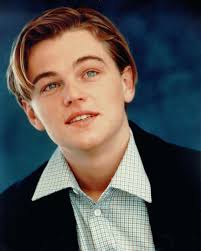
I pictured Chayim as a young
Leonard DiCaprio
In Among the Ruins, just-turned-17-year-old Chayim is forcibly diverted from his life as a peasant-scholar. His parents were told to send him for schooling because of a prophecy. Among his family and teachers, only Chayim did not know that he had a special destiny. Seventeen is the age of adulthood in Chayim's culture and his adventure starts right on his birthday--a nice touch. On his way home from school, Chayim is stalked by a shadow being and is rescued by a wizened old man who carries a walking stick--the Gandalf character. I don't think Hatten stole the idea of Gandalf from Tolkien--I just think that the wise old teacher is a fixture in quest literature. Tolkien got his Gandalf from a much older tradition.

Here's my favorite cinematic Jesus--Ted Neely
from Jesus Christ: Superstar. What might Jesus
have accomplished with a good mentor like
Gandalf?
ASIDE: It is peculiar that the ultimate quest/savior, Jesus, did not have a mentor...or his mentor was lost in the retelling. So much of quest literature is based in Christianity...somehow the mentor character survived his/her exclusion from the Christian story. The disciples were clearly subordinate to Jesus, not advisers or teachers. I'm not a Christian scholar...are there versions of the Jesus story that indicate a mentor? In a sense, I guess his dad was his mentor, except maybe without a walking stick. Please comment if you have feedback on this.
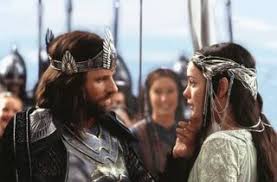
Aragorn had a romance--and a hot French
kiss you can see if you watch the scene in
super slow-mo. Lucky couple!
Anyway, when the mentor, Zidek, rescues Chayim, the adventure begins. Chayim, with the help of various friends and powers, must somehow collect the armor of a great king, which will allow him to prevail in a great battle between good and evil...and bring back the great king (a reference to the second coming of Jesus?) and a time of peace. I will not go into the plot here--don't want to risk any spoilers--but danger, courage, discouragement, betrayal, violence, victory, and love are a part of it. We watch as Chayim grows into his hero role. And, a romance is provided for him, which makes him a tad luckier than Jesus and Frodo!

A thick forest is one of the memorable locations
of Among the Ruins
Hatten presents a coherent worldview for his fantasy--a set of sacred texts, spiritual practices, initiates and intiators. The history of the kingdom is fully present in the present, which is a nice thing. As a reader, I had a strong sense of Chayim's heritage and traditions. This increased the plausibility of the book. The sensory detail was sparse--a polar opposite from Tolkien--and yet I had a physical sense of place. And certainly after Chapter 1, I was fully engaged in this world and retain it as a place I have visited.

The main philosophical question in Among the Ruins seemed to be the conflict between predestination and free will. The author worked hard to reconcile these two ideas...repeatedly and often. Several times, Chayim questions his role in the drama...does his free will mean anything at all in the face of living out a prophecy that was written millenia ago? The issue is not resolved to my satisfaction, but then I am a free will sort of person. I don't believe that "it is written" until I've written it.

My favorite scenes were those in which Chayim felt the pull of the power of creation. In a Joseph Campbell sense, he was open to allurement and followed its energy. Anyway, when the pull started, I knew something amazing was going to happen--an amazing dragon, a display of superhuman powers, some sort of magic. I loved that. And I loved the idea of ancient portals--short cuts--that would open if Chayim would synchronize with the power.

My main problem with this book is that it could use a good copy edit. I'm pretty fussy about grammar and spelling and usage and such, and maybe I'm just old-fashioned. But one of the reasons I would like a major publisher to pick up and publish this terrific book is that they would give it a serious structural edit and a copy edit. I came across "parameter" used for "perimeter" (twice!), and "its/it's" used improperly, and "suites" used for "suits,"  and many other bits of carelessness. I think a good editor would also pep up the opening chapters of the book and jump the reader right into the action.

I will be buying book two of this series probably today. Why don't you go and buy book 1? You'll find it for sale at:
http://www.lulu.com/shop/douglas-hatten/among-the-ruins-of-the-kingdom/paperback/product-18837230.html

Wednesday, March 6, 2013

Starship Troopers, by Robert A. Heinlein

Here you see the full-body
suit and the spider
creatures.
Heinlein strikes again with a compelling first-person narration of the training and maturation of a space warrior. Starship Troopers (1959) tells the story of Johnnie Rico, who enlists in the military on a whim. In this world, only veterans of the military who serve two years or more can become full citizens with the right to vote, but that isn't Johnnie's prime motivation. He just goes along with a friend and then gets caught up in it.

As Johnnie moves through his basic training and then begins service in the mobile infantry (ground fighters who are transported by spaceship), he gains a deeper and deeper understanding of the the role of a warrior and finds that he is maturing into one. I liked Johnnie. I felt like I knew him.

The main enemy Johnnie is fighting is a spidery creature with an ant-like social organization. The infantry drops from the spaceship in multi-layered spheres. As they fall through the atmosphere, layers burn off one by one until finally there is a parachute and then free fall. Each soldier is encased in a huge armored fighting suit that allows him (they are all hims) to jump or bounce, so the final drop to the ground is cushioned by a firing of the bounce thruster--you hit the ground moving. The suit is fitted to the soldier and enhances all of his senses and physical prowess. Pretty cool.


In the movie, the full body armored suit
gives way to mere physique. The spider
is highly exaggerated.
Heinlein really is the master of first-person narration. The style is conversational and self-disclosing, like reading someone's journal or letters home or hearing them tell their story around a campfire or something. I was hooked almost immediately. The book opens with a scene of action and then flashes back to Johnnie's enlistment. The opening action made me eager to read on and find out how this character came to be in this predicament. So, within a few paragraphs, I knew I would finish this book and, truly, I could hardly put it down.

Now, I know I am a science fiction geek, but nothing in the description of Starship Troopers would indicate that I would particularly like it. Indeed, much science fiction writing is bad, bad, bad. But I've loved every Heinlein book I've read (see earlier posts). I attribute to this to Heinlein's terrific writing.

Heinlein justifies restricting the vote to military veterans by citing their willingness to put the needs of the many above their own needs. That places them above the regular everyday Joe. They also have a fantastic desire for survival--after all, dead soldiers don't vote. In the context of this book, that made some sense. Other of Heinlein's ideas for successful government were harder to swallow. He really does think that most people should not vote, for example. I skimmed through most of those sections of the book. However, you can see the author's ideas moving toward Stranger in a Strange Land. Interesting.

I have one more Heinlein book coming in through inter-library loan. I can't wait to get it. Another boost and cheerlead for Robert A. Heinlein.


Someone is grimacing in
almost every image from
the movie.
The 1997 Movie Starship Troopers
The same day that I finished this book, I scrolled through the TV listings and found that the 1997 movie of the same name was being shown that afternoon. The movie was loosely based on this book, but the movie was terrible, an adolescent nightmare of hormones and bravado. The magic of the book was its exploration of one soldier's response to his experiences; the book is not even very action-oriented. Not so the movie. Action was front and center. Every character was beefed up on steroids. Everyone overacted. There was none of the quiet camaraderie of the book. Alas.

The Year 1959
Paul Drake from the TV show Perry Mason
--no hair oil on top, but the sides are
plastered.
I was interested to find that this book was written the same year I was born. However, being set in the future, none of it takes place in 1959. I don't know what insight I might gain about my own life, the mindset into which I was born. If I use Heinlein as a guide, voting rights are not very high on the priority list. Everyone is white, although Johnnie is of Hispanic origins. Surprisingly, women are permitted in the military in Starship Troopers, but only as pilots--they have particular skills in this area, apparently. So, I guess this pretty much sums up 1959. Military solutions are in vogue, as is (as usual) dehumanizing (or buggifying) your enemies. Poor people are invisible.


Danish modern
I am fascinated right now by movies that were filmed in the years my parents were born or got married or the year I was born. I love looking at the fashions and the themes. Earlier in this blog, I reviewed a Perry Mason novel by Erle Stanley Gardner and became re-enamored of this TV series that was set in the very early 1960s and was considered to be somewhat fashion forward. I know that whatever is fashionable NOW seems like reality, so it's fun to see what the reality of my parents and their parents looked like. In the early 1960s, it seemed that we would all always smoke, we would all always have large cars (with running boards!), and Danish modern would prevail. Men would always have their hair oiled (except for Paul Drake) and women would have permanent waves and wear shirtwaists. Perry Mason was ahead in technology, using reel-to-reel tape recorders and other gadgets. My mom liked this TV show. I'm sure it influenced her.


Love the love beads, Janis,
but not the drugstyle.
The expectations of that world also shaped me. We were just coming out of the "man in the gray-flannel suit" period. Retail was everything and my dad managed a shoe store. Conformity was good, but not mandated. Maybe this toe in the 1950s is what makes me think that even if I had been a bit older and therefore qualified to be a hippi, I wouldn't have done it! I just wouldn't buy in to the lifestyle (drugstyle--another new word), even if I bought into the beliefs and the fashions. Who knows?

Today, my expectations are moderate. I no longer worry too much about the fate of the world. I try to practice "here-and-now-ism." What am I doing right now? Where I am I right now? What is happening at this time in this place and what role am I playing? Those are my questions.