Search This Blog

Showing posts with label Joseph Campbell. Show all posts

Sunday, April 14, 2013

Among the Ruins of the Kingdom, by Douglas Hatten

A new entry in the fantasy tradition, Among the Ruins of the Kingdom, by Douglas Hatten, is fast-paced and engaging. Although it started a bit slow, I was hooked by about page 50 and after about page 150 I could not put the book down. Hatten is the cousin of my friend Maryjane Ferguson, a disclaimer that means little in terms of this review. If I had disliked the book I simply would not have reviewed it...so I'm happy to recommend this book to you. It's a touchy thing to review a book by someone you have a connection to. I admit that my tendency is to sheath my claws a bit. Enjoy!

The author, Douglas Hatten
Among the Ruins follows a standard quest format--a teenage boy is selected and identified as the champion of good versus evil. He undergoes numerous trials and contests and gathers allies and magical objects. He gains power and skill as he goes along. This is an entirely predictable formula, repeated again and again in all genres of literature and in uncounted movies and video games. Yet, it works. It still works, even when I know exactly what's going on and even when I am certain of the outcome (the hero prevails). The quest format is a comfortable template upon which to build a story and allows the reader to focus on themes and characters.

I pictured Chayim as a young
Leonard DiCaprio
In Among the Ruins, just-turned-17-year-old Chayim is forcibly diverted from his life as a peasant-scholar. His parents were told to send him for schooling because of a prophecy. Among his family and teachers, only Chayim did not know that he had a special destiny. Seventeen is the age of adulthood in Chayim's culture and his adventure starts right on his birthday--a nice touch. On his way home from school, Chayim is stalked by a shadow being and is rescued by a wizened old man who carries a walking stick--the Gandalf character. I don't think Hatten stole the idea of Gandalf from Tolkien--I just think that the wise old teacher is a fixture in quest literature. Tolkien got his Gandalf from a much older tradition.

Here's my favorite cinematic Jesus--Ted Neely
from Jesus Christ: Superstar. What might Jesus
have accomplished with a good mentor like
Gandalf?
ASIDE: It is peculiar that the ultimate quest/savior, Jesus, did not have a mentor...or his mentor was lost in the retelling. So much of quest literature is based in Christianity...somehow the mentor character survived his/her exclusion from the Christian story. The disciples were clearly subordinate to Jesus, not advisers or teachers. I'm not a Christian scholar...are there versions of the Jesus story that indicate a mentor? In a sense, I guess his dad was his mentor, except maybe without a walking stick. Please comment if you have feedback on this.

Aragorn had a romance--and a hot French
kiss you can see if you watch the scene in
super slow-mo. Lucky couple!
Anyway, when the mentor, Zidek, rescues Chayim, the adventure begins. Chayim, with the help of various friends and powers, must somehow collect the armor of a great king, which will allow him to prevail in a great battle between good and evil...and bring back the great king (a reference to the second coming of Jesus?) and a time of peace. I will not go into the plot here--don't want to risk any spoilers--but danger, courage, discouragement, betrayal, violence, victory, and love are a part of it. We watch as Chayim grows into his hero role. And, a romance is provided for him, which makes him a tad luckier than Jesus and Frodo!

A thick forest is one of the memorable locations
of Among the Ruins
Hatten presents a coherent worldview for his fantasy--a set of sacred texts, spiritual practices, initiates and intiators. The history of the kingdom is fully present in the present, which is a nice thing. As a reader, I had a strong sense of Chayim's heritage and traditions. This increased the plausibility of the book. The sensory detail was sparse--a polar opposite from Tolkien--and yet I had a physical sense of place. And certainly after Chapter 1, I was fully engaged in this world and retain it as a place I have visited.

The main philosophical question in Among the Ruins seemed to be the conflict between predestination and free will. The author worked hard to reconcile these two ideas...repeatedly and often. Several times, Chayim questions his role in the drama...does his free will mean anything at all in the face of living out a prophecy that was written millenia ago? The issue is not resolved to my satisfaction, but then I am a free will sort of person. I don't believe that "it is written" until I've written it.

My favorite scenes were those in which Chayim felt the pull of the power of creation. In a Joseph Campbell sense, he was open to allurement and followed its energy. Anyway, when the pull started, I knew something amazing was going to happen--an amazing dragon, a display of superhuman powers, some sort of magic. I loved that. And I loved the idea of ancient portals--short cuts--that would open if Chayim would synchronize with the power.

My main problem with this book is that it could use a good copy edit. I'm pretty fussy about grammar and spelling and usage and such, and maybe I'm just old-fashioned. But one of the reasons I would like a major publisher to pick up and publish this terrific book is that they would give it a serious structural edit and a copy edit. I came across "parameter" used for "perimeter" (twice!), and "its/it's" used improperly, and "suites" used for "suits,"  and many other bits of carelessness. I think a good editor would also pep up the opening chapters of the book and jump the reader right into the action.

I will be buying book two of this series probably today. Why don't you go and buy book 1? You'll find it for sale at:
http://www.lulu.com/shop/douglas-hatten/among-the-ruins-of-the-kingdom/paperback/product-18837230.html

Sunday, February 5, 2012

Ben-Hur, by Lew Wallace


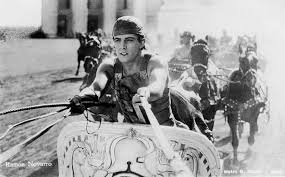
This is the 1925 Ben-Hur.

Ben-Hur, by Lew Wallace (1880) is an odd duck of a book to be on my Eager Readers list, or so it seemed before I read it. But, it truly is a great story, told with currency and urgency and authenticity. I felt like I was right there with Ben-Hur in Jerusalem, in Antioch, in the stands at the chariot race. All in all, it was masterful story telling. And, it made no bones about being a Christian story, so it could be taken on its own terms. The book Ben-Hur is more concise than the movie, tighter, with less melodrama. Ben-Hur is much younger than the Heston portrayal. The main action is Ben-Hur’s vengeance and quest for his family. Everything is presented in that context.

Judah Ben-Hur is a young Jewish prince living in Jerusalem who is wrongly accused of an attack on a Roman official. His punishment is to row in the Roman galleys as a slave; his family and fortune are busted up. His childhood friend, Messala, is in league with the barely wounded procurator to steal everything the Ben-Hur family ever had. In a magnificent battle scene, Ben-Hur rescues a Roman general and is thereby rescued himself from slavery. He gains wealth and status from this adopted father.
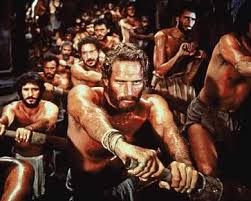
Heston in Ben-Hur 1959, rowing in the galleys
Still, he cannot rest. He must find out what happened to his mother and sister. This quest ennobles Ben-Hur and is a story arc equal to and as important as Ben-Hur’s connection with “the Nazarene,” as they call the imminent Christ.

The story of Jesus is the second story arc. The reader travels with the Wise Men as they find and worship the Christ child. The two arcs are parallel—finding Jesus is sort of like finding your lost family, in the terms of this book; both are ways to find that elusive ideal called Home. And the one journey being concrete while the other is spiritual works very nicely. Ben-Hur and the remaining wise man (Balthasar) are present at the crucifixion, during which Ben-Hur is profoundly changed (and Balthasar is taken directly into heaven with Jesus). This transformation then enables Ben-Hur's earthly happiness, as it makes him acceptable to his childhood love, Miriam. The teachings of Jesus also erase the class differences between them and they are portrayed as living "happily ever after."

The portrayal of the Jewish struggle against Roman domination is a primary theme. Ben-Hur and his friends want a worldly king with armies and power. The desire to overthrow Rome is noble and necessary. They are courageous in their fight for freedom. But the Jews are also presented as having Jesus’s blood on them—they betrayed him to the Romans when he wasn’t the earthly king they wanted. Wallace curses all Jews for all time for betraying Jesus, an accusation that I do not find justified.

The book is a good read, interesting, engaging. Several sequences are riveting—the battle scene during which Ben-Hur escapes the galleys, the chariot race, the transformation of Ben-Hur’s mother and sister. I held my breath through the chariot race, even though I knew exactly how it turned out. I was impressed by how detailed it was—I really felt like I was there. And I wept with Mother and Tirzah as they were healed.

The 1959 film never showed Jesus' face--you
came to know him by the expression on Ben-
Hur's face--a wonderful film-making decision.
And, the story of Jesus is much stronger when seen through the eyes of Ben-Hur than it is when presented directly. Ben-Hur filters it and represents us in skepticism, wonder, and, finally, faith. What a masterful idea Wallace had to write the book in this way.


So, this book was great stuff. I remember liking it when I read it decades ago. And it has held up well. It’s a story of adventure, revenge, redemption, and love. And, it’s a story about an adult emerging from the turmoil of of a child's point of view. I highly recommend it.


Sidebar: Ben-Hur and the Hero Journey

This diagram is based on the work of Joseph Campbell.
If you've followed my blog, you know that tracing the role of the hero quest in the literature I'm reading is an underlying theme. I watch out for it because it is specified by Joseph Campbell (one of my personal heroes) as found in the stories and literature of almost every culture. How does a person grow up? The hero quest stories present the journey for us, demonstrating the pitfalls, dangers, diversions, and the great rewards of taking the path to enlightenment/full adulthood. Ben-Hur loses himself--his name and home are stripped from  him. He doesn't even own himself, as a galley slave. The book presents his struggle to find himself--by finding his courage, his cause, his family, his salvation. He acquires tools and gifts that he uses to complete his quest. What video game could want more? Christian game designers, what are you waiting for? This hero journey is ripe for the picking.

Sidebar: Lew Wallace

I love this quote by Lew Wallace--it's my dream, too. I found it at http://thinkexist.com/quotes/lew_wallace/.

"I know what I should love to do--to build a study; to write, and to think of nothing else. I want to bury myself in a den of books. I want to saturate myself with the elements of which they are made, and breathe their atmosphere until I am of it. Not a bookworm, being which is to give off no utterances; but a man in the world of writing--one with a pen that shall stop men to listen to it, whether they wish to or not."

The following link presents a brief history of Wallace's military career. He was a man of action as well as a writer. (I don't know why I don't think those things go together!):